Preloader Close
Starting a roofing company in 2026 requires $30,000–$80,000 in startup capital, a contractor license (required in most states), general liability insurance ($3,000–$8,000/year), workers’ compensation ($7,500–$15,000/year), an LLC business structure, and basic equipment including a truck ($15,000–$45,000) and trailer ($3,000–$8,000) with new roofing companies typically generating $150,000–$500,000 in revenue during year one depending on market size, crew size, and marketing investment. The U.S. roofing industry generates over $56 billion annually and remains one of the most recession-resistant trades, as roofs require replacement regardless of economic conditions.
Table of Contents
The roofing industry offers one of the clearest paths to entrepreneurship in the skilled trades: high demand, recurring work driven by weather and aging housing stock, strong profit margins of 15–30% net on residential projects, and relatively low barriers to entry compared to other construction trades. According to the U.S. Bureau of Labor Statistics, roofing employment is projected to grow 5% through 2032, and with over 5 million residential roofs replaced annually in the U.S., new roofing companies with strong local marketing and quality workmanship can establish profitable operations within 12–18 months of launch.
This complete 2026 guide walks through every step required to start a roofing company from business planning and licensing to insurance, equipment, pricing, hiring, and digital marketing with specific cost figures, state-by-state licensing notes, and actionable strategies for landing your first contracts.
Why Start a Roofing Company in 2026?
Before diving into the how-to, understanding why roofing is one of the best trades businesses to launch establishes the strategic foundation for everything that follows.
Market Opportunity
The U.S. residential roofing market processes approximately 5–6 million roof replacements per year, driven by aging housing stock (the median U.S. home is 40+ years old), severe weather events (hailstorms alone cause $15+ billion in property damage annually), and growing demand for energy-efficient and premium roofing materials. Roofing companies that establish strong local reputations can build consistent revenue streams from insurance storm work, planned replacements, and commercial maintenance contracts.
Financial Potential
Residential roofing companies in established markets generate:
- Year 1 revenue: $150,000–$500,000 (owner-operator + 1–2 crew members)
- Year 3 revenue: $500,000–$2,000,000+ (multiple crews, diversified services)
- Net profit margins: 15–30% on residential replacement jobs
- Average job revenue: $8,000–$18,000 per residential roof replacement
Recession Resistance
Unlike discretionary home improvement projects, roof replacements are largely non-negotiable a leaking or storm-damaged roof must be addressed regardless of economic conditions. This makes roofing one of the most recession-resistant service businesses, with demand remaining stable or increasing during economic downturns when homeowners delay other renovations but cannot postpone urgent roof repairs.
Step 1: Develop Your Roofing Business Plan
Every successful roofing company starts with a written business plan that defines your market, services, financial targets, and competitive positioning before spending a single dollar on equipment or licenses.
Define Your Service Offerings
Decide which roofing services your company will provide from day one:
Core Services (recommend starting here):
- Residential asphalt shingle replacement
- Storm damage assessment and insurance claim assistance
- Roof repair and emergency leak response
- Roof inspection services
Expansion Services (add after 12–18 months of operation):
- Metal roofing installation
- Flat/low-slope commercial roofing
- Gutter installation and replacement
- Skylight installation
- Roof cleaning and maintenance programs
Specializing in residential asphalt replacement at launch simplifies training, estimating, and material purchasing while allowing you to build volume and reputation before expanding to higher-complexity work.
Define Your Service Area
Identify your target geographic market:
- Primary radius: 20–30 miles from your home base for initial operations
- Population density: Urban/suburban markets support higher job volume and faster growth
- Competition analysis: Research existing roofing companies in your target area using Google Maps, Angi, and HomeAdvisor identify gaps in coverage, response time, or specialty services
- Storm corridor advantage: If your region experiences frequent hail or wind events (Texas, Oklahoma, Colorado, Midwest), storm-driven insurance work can accelerate early revenue dramatically
Financial Projections
Build a realistic 3-year financial model:
Year 1 targets (owner-operator + 2 crew members):
- Jobs per month: 4–8 residential replacements
- Average job revenue: $8,000–$14,000
- Monthly revenue: $32,000–$112,000 (weather-dependent; peak in spring/fall)
- Annual gross revenue: $200,000–$600,000
- Net profit (after materials, labor, overhead): $30,000–$90,000
Year 3 targets (2 crews):
- Jobs per month: 15–30
- Annual gross revenue: $750,000–$2,500,000
- Net profit: $112,500–$500,000
Step 2: Choose Your Roofing Company Business Structure
Business structure determines your personal liability exposure, tax treatment, and administrative requirements one of the most important early decisions for any new roofing company.
Business Structure Options
Sole Proprietorship:
- Simplest structure no separate business registration required in most states
- Critical disadvantage: Zero legal separation between business and personal assets; a lawsuit or major liability claim can take your home, savings, and vehicles
- Not recommended for roofing given the high injury and property damage risk
LLC (Limited Liability Company) Recommended:
- Protects personal assets from business liabilities
- Flexible tax treatment (taxed as sole proprietor, partnership, or S-Corp)
- Formation cost: $50–$500 depending on state (most average $100–$200)
- Requires operating agreement and annual report filings
- Best choice for most new roofing companies
S-Corporation:
- Preferred structure once revenue exceeds $80,000–$100,000/year
- Allows owner to split income between salary and distributions, reducing self-employment tax
- More administrative complexity than LLC
- Best for established roofing companies generating $500,000+ annually
Partnership:
- Appropriate when starting with a business partner
- Requires formal partnership agreement defining ownership percentages, decision rights, and exit provisions
- Still exposes partners to personal liability without LLC protection
“An LLC is non-negotiable for roofing contractors. One uninsured incident a worker injury, a damaged vehicle, a botched installation can result in a judgment exceeding your business assets. An LLC keeps that judgment away from your personal finances.” – License to Build Contractor Guide, 2026
Registration Steps for LLC
- Choose a business name (verify availability in your state’s Secretary of State database)
- File Articles of Organization with your state ($50–$500 fee)
- Obtain an EIN (Employer Identification Number) from IRS.gov free, takes 5 minutes
- Open a dedicated business bank account (keep personal and business finances completely separate)
- Create an Operating Agreement defining ownership and management structure
- Register for state and local business licenses as required
Step 3: Get Licensed and Meet Legal Requirements
Licensing requirements for roofing companies vary significantly by state some require passing trade exams and proving years of experience; others have no state license at all.
State Licensing Overview
Key licensing requirements in major states:
- California: C-39 Roofing Contractor license required; pass law and trade exams; 4 years journey-level experience
- Florida: Certified Roofing Contractor license required; exam, experience proof, continuing education
- Texas: No state license; some municipalities require local registration
- Colorado: No state license; check county and city requirements
Federal Requirements
Regardless of state:
- EIN: Required for hiring employees and opening business accounts (free at IRS.gov)
- OSHA Compliance: Fall protection standards (29 CFR 1926.502) are the most critical; OSHA 10 or 30 certification is strongly recommended for all crew leaders
- EPA Lead-Safe Certification: Required when disturbing paint on pre-1978 homes during roofing work RRP (Renovation, Repair, and Painting) Rule compliance is federally mandated
Surety Bond Requirements
Most states requiring licensing also require surety bonds:
- Bond amount: Typically $10,000–$25,000
- Annual cost: $200–$500 for $10,000–$25,000 bond (1–3% of face value)
- Purpose: Protects customers if contractor defaults on a project or violates license terms
Step 4: Secure Roofing Business Insurance
Roofing carries higher liability exposure than almost any other construction trade, making comprehensive insurance coverage non-negotiable before starting any work.
Required and Recommended Coverage
| Insurance Type | Coverage | Annual Cost | Required? |
|---|---|---|---|
| General Liability | $1–$2 million per occurrence | $3,000–$8,000 | Yes (most clients/states) |
| Workers’ Compensation | Medical + lost wages for injured workers | $7,500–$15,000 | Yes (most states when hiring) |
| Commercial Auto | Work vehicles accident/damage/theft | $1,500–$4,000 | Yes (for company vehicles) |
| Tools & Equipment | Replacement of stolen/damaged tools | $500–$1,500 | Recommended |
| Professional Liability | Errors, omissions, faulty workmanship | $800–$2,000 | Recommended |
| Umbrella Policy | Additional coverage beyond other policy limits | $500–$1,500 | Strongly recommended |
Total annual insurance budget: $8,000–$23,000 for a small roofing company with 2–4 employees.
Workers’ Compensation Rate Note
Workers’ compensation rates for roofing are among the highest of any trade due to fall injury risk:
- Rate: $15–$30 per $100 of payroll (versus $2–$5 for many other trades)
- On a $50,000 annual payroll: $7,500–$15,000 in workers’ comp premiums alone
- Proper OSHA fall protection training and documented safety programs can reduce rates by 10–25% through experience modification rating improvements over time
“Workers’ compensation insurance for roofing contractors typically costs 3–6× more than equivalent coverage for general carpenters or painters. New roofing business owners should budget conservatively for this expense as it’s often the largest single insurance line item.” – ServiceTitan Roofing Business Guide, 2026
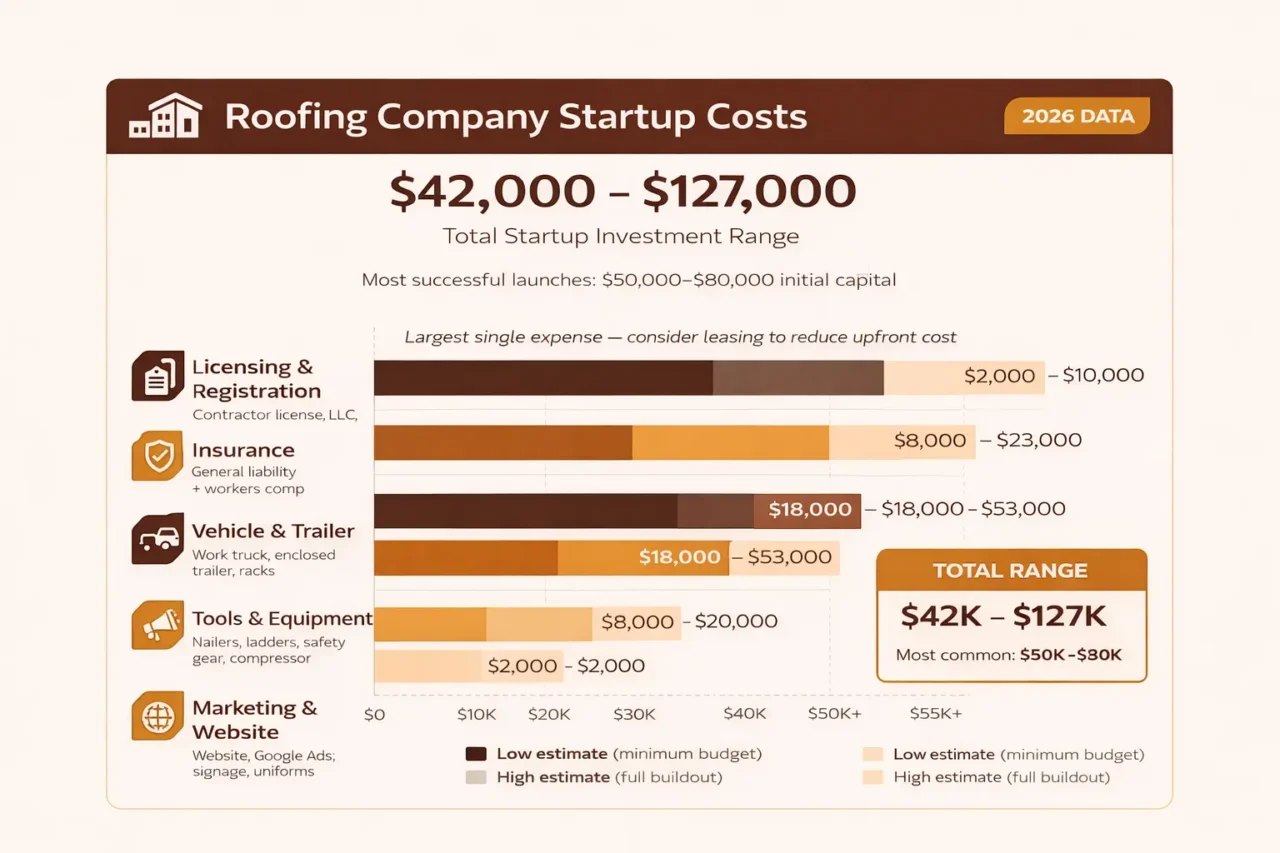
Step 5: Calculate Startup Costs
Understanding the full capital requirement prevents the most common failure mode for new roofing companies running out of cash before generating consistent revenue.
Complete Startup Cost Breakdown
| Category | Low Estimate | High Estimate | Notes |
|---|---|---|---|
| Business registration + legal | $500 | $2,000 | LLC formation, contracts, attorney fees |
| Contractor license + bonds | $2,000 | $10,000 | Varies significantly by state |
| General liability insurance | $3,000 | $8,000 | Annual premium upfront |
| Workers’ compensation | $5,000 | $15,000 | Required when hiring crew |
| Commercial vehicle (truck) | $15,000 | $45,000 | Used F-250/350 or similar |
| Trailer | $3,000 | $8,000 | Materials and debris hauling |
| Tools and equipment | $3,000 | $8,000 | Nail guns, ladders, safety gear |
| Safety equipment | $1,500 | $4,000 | Harnesses, helmets, fall protection |
| Initial material inventory | $2,000 | $5,000 | First 2–3 jobs stock |
| Website + digital marketing | $1,500 | $5,000 | Website build + initial ads |
| Business software | $500 | $2,000 | Estimating, CRM, accounting |
| Working capital reserve | $5,000 | $15,000 | 2–3 months operating expenses |
| Total Startup Investment | $42,000 | $127,000 | Most start at $50,000–$80,000 |
Startup Financing Options
- Personal savings: Most common; avoids debt but requires capital accumulation
- SBA 7(a) loans: Government-backed loans up to $500,000 at competitive rates for qualified businesses
- Equipment financing: Finance truck and trailer separately (20–30% down, 3–5 year term)
- Business credit cards: For tools and initial marketing (pay monthly to build credit)
- Manufacturer credit programs: GAF, Owens Corning, and CertainTeed offer material financing to certified contractors
- Angel investors or business partners: Bring in equity partner with capital in exchange for ownership percentage
Step 6: Purchase Equipment and Set Up Operations
Essential Equipment List
Vehicles and Transport:
- 1-ton pickup truck (F-250, F-350, Ram 2500/3500): Primary for crew transport and towing
- 16–18 ft equipment trailer: Materials delivery and debris haul-off
- Budget: $18,000–$53,000 combined
Roofing Tools (per crew):
- Pneumatic roofing nail guns (2–3): $150–$350 each
- Air compressor (6-gallon minimum): $200–$500
- Extension ladders (24 ft and 32 ft): $300–$600 each
- Roof jacks and planks: $200–$400
- Hook blades and utility knives: $40–$80
- Pry bars and shingle shovels: $80–$150
- Chalk line and tape measures: $30–$60
- Caulking guns and sealant tools: $30–$60
Safety Equipment (non-negotiable per OSHA 1926.502):
- Full-body harnesses: $80–$150 per worker
- Roof anchors and rope systems: $200–$500
- Hard hats: $25–$60 each
- Safety glasses and gloves: $20–$40 per worker
- Non-slip work boots: $80–$180 per worker
Business Operations:
- Laptop or tablet for estimates: $500–$1,200
- Measuring wheel or drone (optional but recommended): $100–$3,000
- Printer for contracts and permits: $150–$300
- Phone plan with data for field communication: $50–$100/month
Roofing Software for New Companies
- Estimating: EagleView or iRoofing (satellite measurement, $150–$300/month)
- CRM and job management: JobNimbus, AccuLynx, or Roofr ($100–$300/month)
- Accounting: QuickBooks Online ($30–$90/month)
- Proposal software: Roofr or JobNimbus integrated proposals
Step 7: Set Your Pricing Strategy
Pricing roofing jobs correctly from day one is critical underpricing wins jobs but destroys cash flow, while overpricing loses bids in competitive markets.
Understanding Roofing Job Costs
Material costs (typical residential asphalt replacement):
- Architectural shingles: $80–$120 per square (100 sf)
- Underlayment: $15–$30 per square
- Decking repair (estimate 5–10% of area): $2–$4/sf
- Ridge cap, starter, ice and water shield: $15–$25 per square
- Drip edge, flashing, vents: $200–$600 per project
- Total material cost per square: $115–$190
Labor costs:
- Crew of 3–4 workers: $300–$500 per square installed
- Owner-operator time: Value at $75–$125/hour for estimating
- Subcontractor crews: $150–$250 per square (if using subs)
Overhead costs to include in pricing:
- Insurance allocation per job: $200–$400
- Vehicle and equipment amortization: $100–$200
- Software, phone, marketing: $150–$250
- Office/administrative costs: $100–$200
Profit margin:
- Minimum target: 15% net profit
- Healthy roofing company: 20–30% net profit
- New company building reputation: Accept 12–15% while establishing reviews
Sample Job Pricing Calculation
20-square (2,000 sf) residential asphalt replacement:
| Component | Cost |
|---|---|
| Materials | $2,800–$4,200 |
| Labor (3-person crew, 1 day) | $1,200–$1,800 |
| Overhead allocation | $550–$850 |
| Total cost | $4,550–$6,850 |
| 25% profit margin | $1,138–$1,713 |
| Job price to customer | $5,688–$8,563 |
| Typical market rate | $6,000–$9,000 |
Pricing Models
Per-square pricing: Most common price per 100 sf of roof area. Simplest for estimating and customer comparison.
Itemized line-item pricing: Detailed breakdown of each cost component. Builds customer confidence and reduces price objections by demonstrating value.
Flat-rate pricing: Fixed price for standard job types (e.g., $7,500 for any 20-square 3-tab replacement). Simplifies sales but requires accurate cost modeling.
Step 8: Build Your Roofing Company Brand and Online Presence
In 2026, 85% of homeowners begin their contractor search online before making first contact your digital presence directly determines how many leads your roofing company receives.
Essential Digital Marketing Assets
Professional Website (Priority #1):
Your roofing company website must include:
- Clear service description with service area
- Photo gallery of completed projects (real photos – not stock)
- Customer testimonials and Google review integration
- Clear call-to-action (phone number prominent on every page)
- Contact form for estimate requests
- Mobile-optimized design (60%+ of searches are mobile)
Google Business Profile (Priority #2):
- Claim and fully optimize your Google Business listing
- Add all services, hours, photos, and complete contact information
- Respond to every review – positive and negative
- Add weekly posts showing completed projects
- This is the single highest-ROI marketing action for a new roofing company
Local SEO (Priority #3):
- Target keywords: “[City] roofing company”, “[City] roof replacement”, “[City] storm damage roof repair”
- Create location-specific content pages for each city/area served
- Build citations (business listings) on Yelp, Angi, HomeAdvisor, BBB, and industry directories
- Consistent NAP (Name, Address, Phone) across all listings
Paid Advertising for New Roofing Companies
Google Local Services Ads (LSAs):
- Pay-per-lead rather than pay-per-click
- Verified badge increases customer trust
- Average cost per lead: $40–$120 for roofing
- Best for immediate lead generation while organic SEO builds
Google Search Ads:
- Target high-intent keywords: “roof replacement near me,” “storm damage roof repair”
- Average cost per click: $8–$25 for roofing terms
- Effective for new companies without organic rankings
- Budget: $500–$2,000/month minimum for meaningful results
Facebook and Instagram Ads:
- Effective for retargeting website visitors and targeting homeowners by age/income/location
- Before/after photos and project showcases perform well
- Budget: $300–$800/month
Offline Marketing Strategies
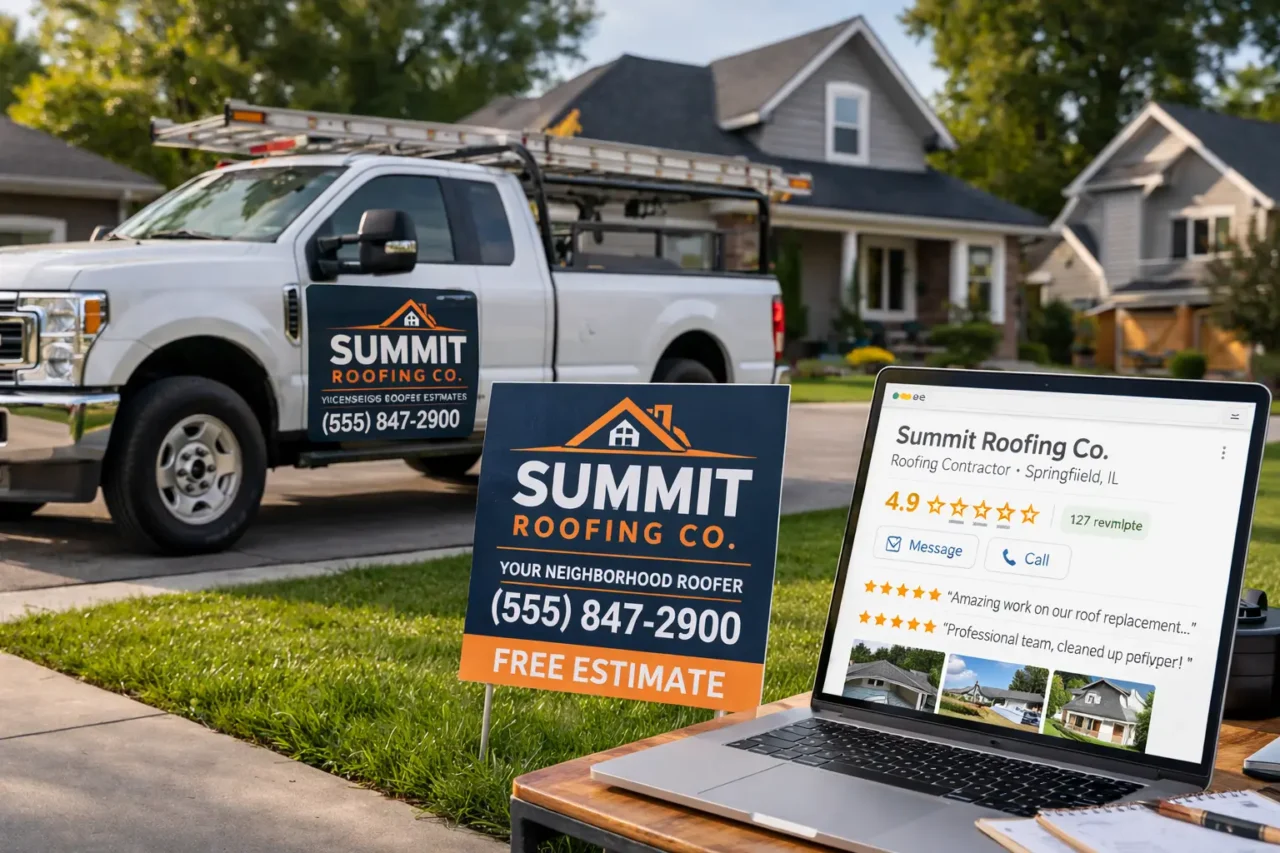
- Yard signs: Place signs at every active job site; neighbors observe and inquire
- Door hangers: Distribute in neighborhoods where you’re actively working (“We just roofed your neighbor’s home at 123 Main St…”)
- Vehicle branding: Wrap truck and trailer with company name, phone, and services -estimated 30,000–70,000 impressions daily in urban areas
- Referral program: Offer $200–$500 referral fee to past customers for every new job referred
- Realtor and insurance agent partnerships: Realtors need pre-listing roof inspections; insurance agents connect adjusters with quality contractors for storm claims
Step 9: Hire and Manage Your First Roofing Crew
When to Hire
Most roofing company owners start as owner-operators, doing physical roofing work alongside 1–2 helpers for the first 6–12 months. Hire your first dedicated crew when:
- You have consistent weekly job flow (at least 2–3 jobs per week)
- Administrative work is consuming time that should be spent selling
- Physical roofing alongside crew is limiting your business development activities
- Revenue supports crew payroll without cash flow risk
Hiring Options: W-2 Employees vs Subcontractors
W-2 Employees:
- You withhold payroll taxes, provide workers’ comp and benefits
- Greater control over quality, schedule, and procedures
- Higher administrative burden and fixed costs
- Best for core crew you want to retain long-term
Subcontractors (1099):
- They provide their own tools, insurance, and tax compliance
- More flexible use more capacity in busy periods, less in slow periods
- Risk: IRS scrutiny of contractor classification must pass the “ABC test” in many states
- Subcontractor crews must carry their own workers’ compensation to avoid your liability
- Best for occasional overflow work while building permanent crew
Crew Composition for a 1-Crew Operation
Minimum viable crew:
- 1 crew leader (experienced roofer hire this person first)
- 2 laborers/helpers
- Owner managing, selling, and often working on-site
Compensation benchmarks (2026):
- Crew leader: $25–$40/hour or $250–$400/day
- Experienced roofer: $20–$32/hour
- Laborer/helper: $15–$22/hour
- Subcontractor crew (3-person): $150–$250/square installed
OSHA Safety Requirements (Non-Negotiable)
OSHA’s residential roofing standards require:
- Fall protection for all work at 6+ feet elevation (residential roofing standard 29 CFR 1926.502)
- Personal fall arrest systems (harnesses + anchors) OR safety nets OR guardrails
- OSHA 10-hour training minimum for all crew members
- Daily toolbox safety talks (document in writing)
- Ladder safety compliance: extension ladders must extend 3 ft above landing; secured top and bottom
- Personal protective equipment: hard hats, safety glasses, non-slip footwear
OSHA violation consequences:
- Serious violation: $16,131 per violation
- Willful/repeated violation: Up to $161,323 per violation
- Fall-related fatalities can result in criminal prosecution
Step 10: Scale Your Roofing Company
After successfully completing your first 20–30 jobs and establishing operational systems, growth becomes the focus.
Growth Levers for Roofing Companies
Manufacturer Certification Programs:
- GAF Master Elite® certification (top 3% of GAF contractors)
- Owens Corning Preferred Contractor
- CertainTeed SELECT ShingleMaster™
- Benefits: Enhanced warranties to offer customers (50-year systems), manufacturer leads, co-op marketing funds, competitive differentiation
- Requirement: Volume minimums, quality inspections, training
Storm Chasing and Insurance Work:
- Develop relationships with public adjusters and insurance agents
- Learn Xactimate estimating software (industry standard for insurance claims)
- Build a process for documenting storm damage, filing claims, and supplementing with insurance adjusters
- Insurance replacement jobs average $12,000–$20,000 significantly above standard replacement work
Adding Commercial Roofing:
- Commercial flat roofing (TPO, EPDM, modified bitumen) is higher complexity but larger contracts ($50,000–$500,000+)
- Requires additional training, certifications, and equipment
- Best pursued after 2–3 years of successful residential operation
Adding Complementary Services:
- Gutter installation: Natural upsell on every reroofing job ($1,200–$2,800 average)
- Roof inspections: $150–$350 per inspection, low overhead, generates replacement pipeline
- Roof cleaning: $300–$700 average, excellent marketing touchpoint
- Attic insulation: Often upsold during roof inspection
Roofing Company Profitability and Financial Management
Key Performance Metrics to Track
| Metric | Healthy Benchmark | Warning Signal |
|---|---|---|
| Gross profit margin | 35–50% | Below 30% |
| Net profit margin | 15–30% | Below 10% |
| Material cost as % of revenue | 35–45% | Above 50% |
| Labor cost as % of revenue | 20–30% | Above 35% |
| Marketing cost as % of revenue | 8–15% | Above 20% |
| Close rate on estimates | 35–55% | Below 25% |
| Average job revenue | $8,000–$16,000 | Below $6,000 |
| Revenue per crew per day | $2,000–$4,000 | Below $1,500 |
Cash Flow Management
Roofing companies face seasonal cash flow volatility peak revenue in spring and fall, slower winters in northern markets:
- Require deposits: Standard practice is 30–40% deposit at contract signing, balance upon completion
- Invoice immediately: Submit final invoice same day as job completion
- Establish a business line of credit: $25,000–$100,000 line available before you need it not after
- Retain 3 months operating expenses in reserve: Cover payroll and overhead during slow periods
- Negotiate material terms: Most distributors offer net-30 terms for established contractors use to improve cash position
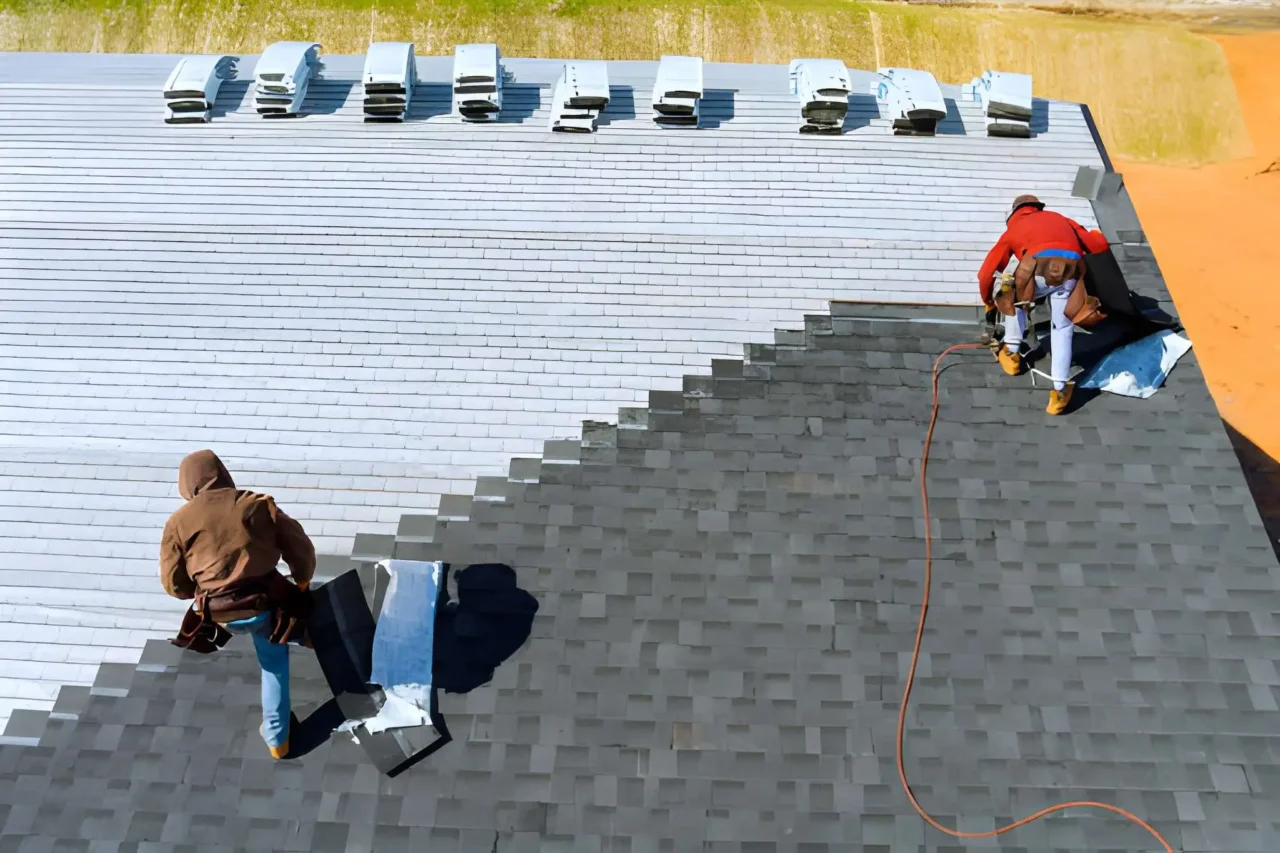
can complete a 20-square residential replacement in one day, generating
$6,000–$10,000 in revenue per crew day
Frequently Asked Questions
How much does it cost to start a roofing company?
Starting a roofing company costs $42,000–$127,000 in total startup capital, with most new roofing companies launching on $50,000–$80,000. The largest expenses are vehicle and trailer ($18,000–$53,000), insurance ($8,000–$23,000 annually), licensing and bonding ($2,000–$10,000), and working capital reserves ($5,000–$15,000). Owner-operators who start small with minimal crew and used equipment can launch for as little as $30,000.
Do I need a license to start a roofing company?
License requirements vary by state. States like Florida, California, and Arizona require full roofing contractor licenses involving trade exams, experience verification, and surety bonds. States like Texas, Colorado, and Kansas have no state license requirement, though local permits may apply. Always verify requirements with your state licensing board before operating working without required licenses exposes you to fines, inability to pull permits, voided insurance claims, and personal lawsuit liability.
How profitable is a roofing company?
Roofing companies generate net profit margins of 15–30% on residential replacement jobs. A single-crew roofing company completing 4–6 jobs per month at $10,000 average generates $480,000–$720,000 in annual revenue, with $72,000–$216,000 in net profit. Two-crew operations can generate $1,000,000–$2,500,000 in revenue with $150,000–$500,000+ net profit. Storm damage markets and insurance claim work typically generate the highest margins.
Can I start a roofing company with no experience?
Starting a roofing company with no field experience is legally possible in some states but practically very risky poor installation quality generates warranty callbacks, insurance claims, and reputation damage that destroys new companies quickly. Most successful roofing company owners have 2–5 years of field experience before launching independently. If you lack experience, consider spending 1–2 years working for an established roofing company first, or partner with an experienced crew leader who handles field operations while you manage sales and business development.
What insurance does a roofing company need?
Every roofing company needs at minimum: general liability insurance ($1–$2 million coverage, $3,000–$8,000/year), workers’ compensation ($7,500–$15,000/year for a small crew), and commercial auto insurance ($1,500–$4,000/year). Strongly recommended additions include tools and equipment coverage ($500–$1,500/year), professional liability/errors and omissions ($800–$2,000/year), and an umbrella policy ($500–$1,500/year). Total annual insurance budget for a 2–4 person roofing company runs $8,000–$23,000.
How do I get my first roofing customers?
The fastest paths to first roofing customers are: Google Business Profile optimization (free, high-intent local searches), yard signs at every job site ($5–$15 per sign), HomeAdvisor or Angi lead services ($30–$80 per lead), door hangers in neighborhoods where you’re working, and referrals from friends and family. Most new roofing companies land their first 10–20 jobs through personal networks, then transition to digital marketing for scale. Offering a competitive price and exceptional cleanup and communication on early jobs generates the 5-star reviews that fuel organic growth.
What is the best business structure for a roofing company?
An LLC (Limited Liability Company) is the best structure for most new roofing companies it protects personal assets from business liabilities, offers flexible tax treatment, costs only $50–$500 to form, and is recognized and respected by customers, insurance companies, and material suppliers. Sole proprietorships should be avoided in roofing due to the high injury and property damage liability exposure. S-Corporation election (through the LLC) becomes advantageous once annual net income exceeds $80,000–$100,000.
How long does it take to start making money with a roofing company?
Most new roofing companies generate their first paying jobs within 30–60 days of launch if marketing is started immediately. Breaking even on startup costs typically takes 6–12 months. Building a consistently profitable operation with reliable crew, repeat customer base, and strong online reviews generally takes 12–24 months. Companies that invest in digital marketing from day one, obtain manufacturer certifications within year one, and focus relentlessly on quality and customer service reach profitability faster than those who rely solely on word of mouth.
What equipment do I need to start a roofing company?
Essential startup equipment includes: 1-ton truck ($15,000–$45,000), equipment trailer ($3,000–$8,000), pneumatic nail guns (2–3 units at $150–$350 each), air compressor ($200–$500), extension ladders (24 ft and 32 ft, $300–$600 each), roof jacks and planks ($200–$400), OSHA-compliant fall protection per worker ($280–$650 each), and estimating software ($150–$300/month). Total tool and equipment investment for a complete 3-person crew runs $8,000–$20,000 excluding vehicle and trailer.
How do roofing companies find work in slow seasons?
Roofing companies maintain revenue in slow seasons (winter in northern markets) through several strategies: commercial flat roofing and maintenance contracts (year-round work regardless of weather); storm damage repairs (emergency response work available any season); interior work like attic insulation (weather-independent service); marketing budget shifts toward spring aggressive advertising in January–February generates leads ahead of the spring rush; and customer maintenance programs (annual inspection agreements that keep your name in front of existing customers year-round).
🏠 Roofing Tips & Updates
Get free roofing advice, cost guides, and seasonal maintenance tips.

Rinuom Danuom is the editor of Roof-Installation.com, an independent roofing guide for US homeowners. Rinuom researches roofing costs, materials and installation methods using published US cost data, manufacturer specifications and building-code references, and maintains the site’s free roofing calculators. Roof-Installation.com does not install roofs or take contractor commissions. Spotted an error? Email [email protected].
Leave A Comment