Preloader Close
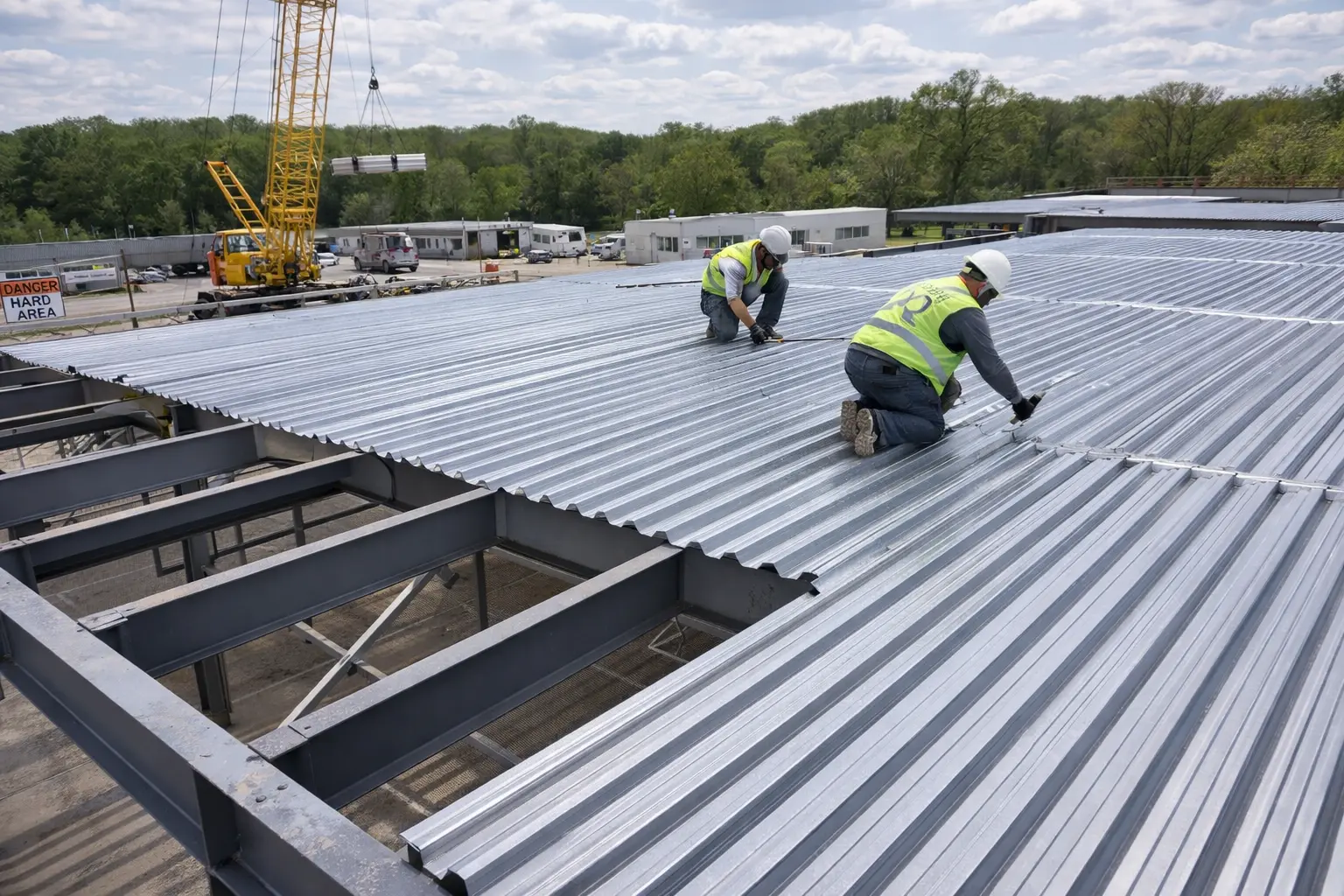
Steel roof deck is corrugated structural sheet steel that supports roof assemblies on commercial, industrial, and some residential buildings, and understanding profile types, gauge selection, and fastening methods helps control roof installation cost and performance. Industry data shows steel roof deck materials typically cost $3–$7 per square foot, with installed pricing running $6–$13/sf depending on gauge, profile, spans, and labor conditions.
This guide explains what a steel roof deck is, the most common profiles (B deck vs N deck), how gauge affects cost and span capacity, typical installation methods, and what drives total roof installation cost when you factor in the full roof assembly.
Table of Contents
What is a steel roof deck?
A steel roof deck is a cold-formed, corrugated steel panel installed over structural steel or bar joist framing to create a roof diaphragm and base for insulation and weatherproofing membranes. The Steel Deck Institute (SDI) publishes design standards and load tables for steel roof deck, underscoring that profile selection, gauge, and span are engineering decisions tied to structural codes.
In practice, steel roof deck serves three jobs: it carries roof loads (live, dead, wind, snow), acts as a lateral diaphragm to resist horizontal forces, and provides a substrate for the roof assembly above.
Steel roof deck profiles: B deck vs N deck (and others)
Most commercial projects use one of these standard profiles, each optimized for different spans and loading conditions.
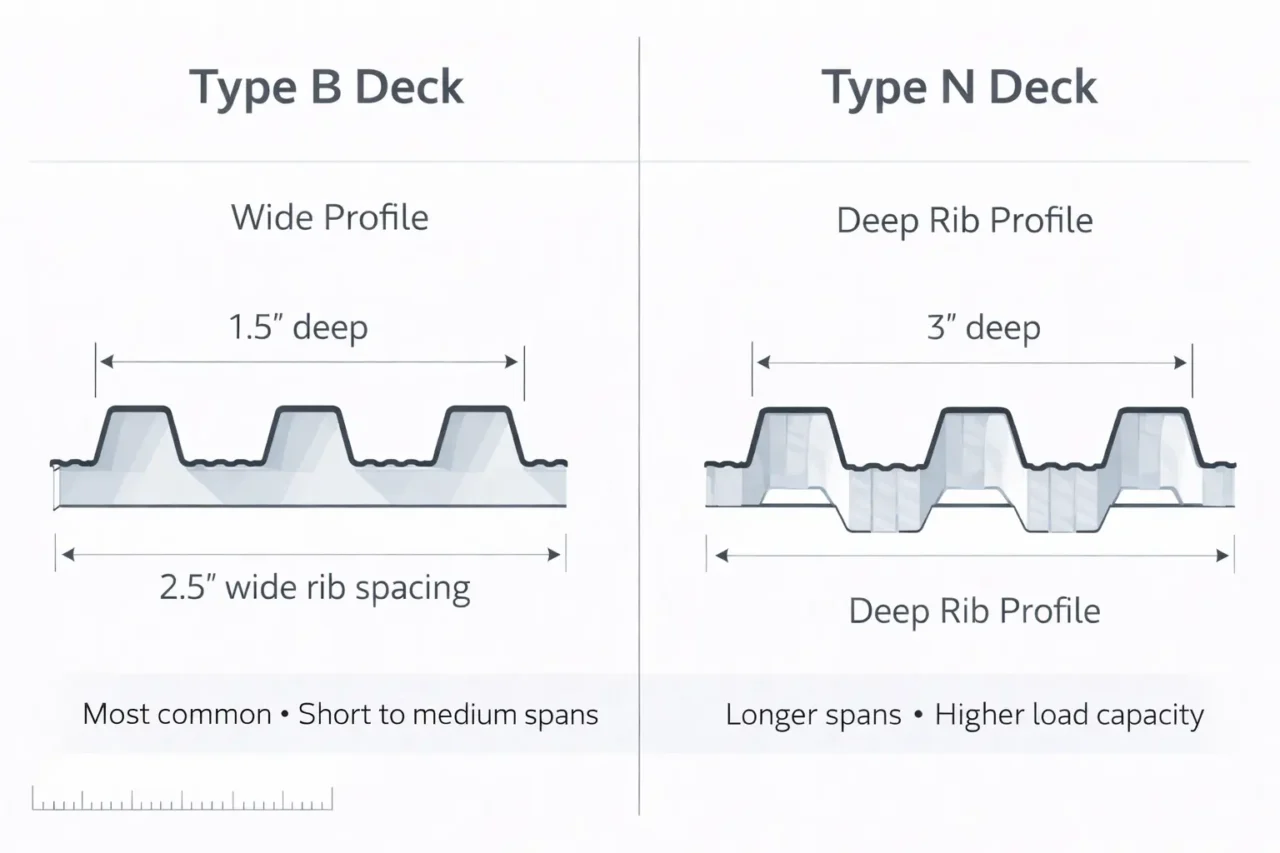
Type B deck (wide rib, 1.5-inch depth)
Type B is a 1.5-inch deep wide rib steel roof deck, widely used for its strength-to-economy balance. SDI’s manual describes Wide Rib (WR) – B as a common deck profile, and notes that currently used insulation thicknesses can span the rib opening, making B deck compatible with a wide range of roof assemblies.
Type N deck (3-inch deep rib)
Type N is a 3-inch deep rib profile (also called 3DR – N in SDI terminology) designed for longer spans than 1.5-inch deck. The SDI Roof Deck Design Manual notes that because of the greater span length and rib spacing, particular attention is needed for uplift anchorage of this deck in high wind zones.
Long span profiles (4.5″, 6″, 7.5″)
The SDI manual also describes long span profiles (depths of 4.5, 6, and 7.5 inches) designed to carry roof loads over spans of up to 35 feet. These are less common but critical for buildings with wide bay spacing where intermediate supports aren’t practical.
Steel roof deck gauges (thickness and weight)
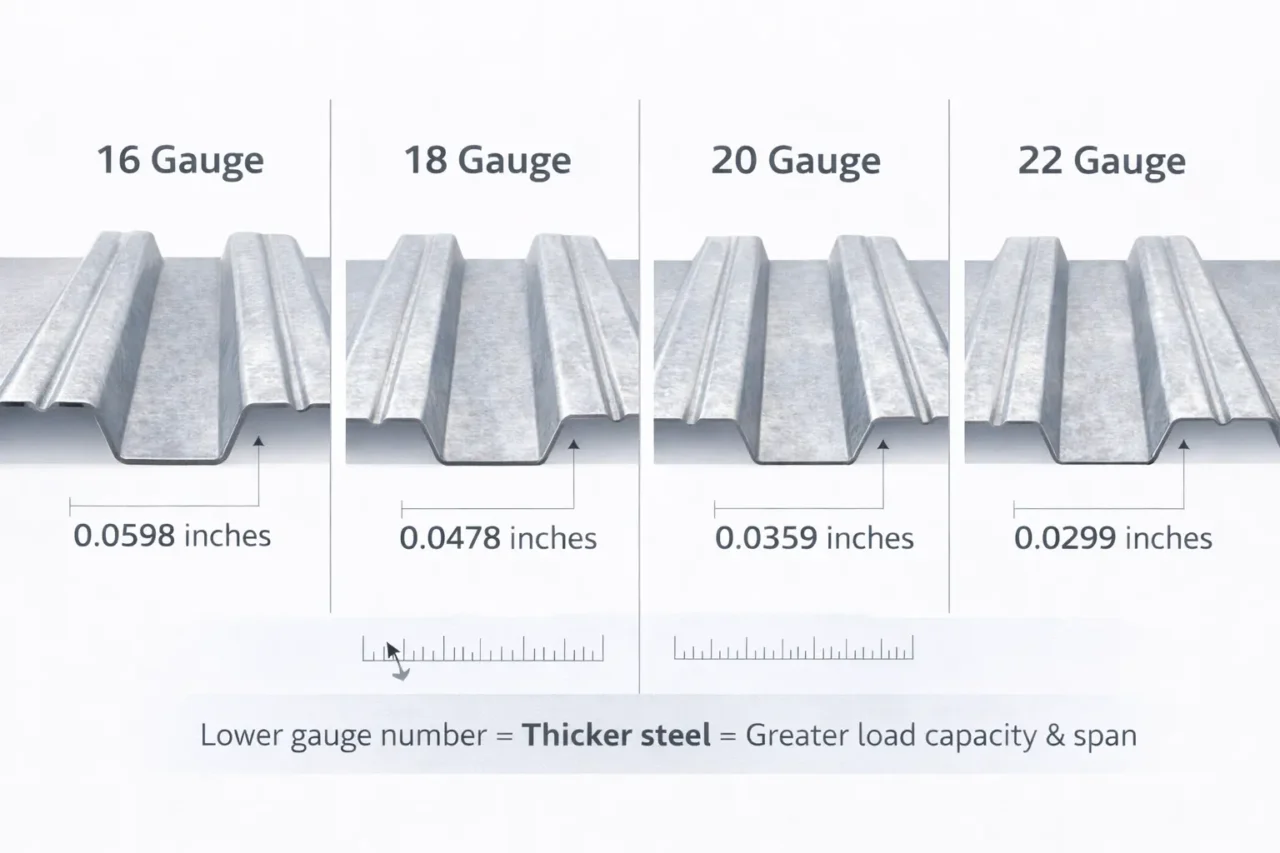
Steel roof deck thickness is specified by gauge number; lower gauge numbers mean thicker, heavier steel.
Common gauges for steel roof deck include 22, 20, 18, and 16. SDI’s manual provides deck type notation examples such as 22 (0.0295″) thickness, showing the relationship between gauge and actual steel thickness. Heavier gauges increase load capacity and span capability but also raise material cost and handling weight.
Steel roof deck installation: fastening methods
Steel roof deck is attached to structural framing using welds or mechanical fasteners, and no substitution of fastener type or pattern should be made without the designer’s approval.
Arc spot welding (puddle welds)
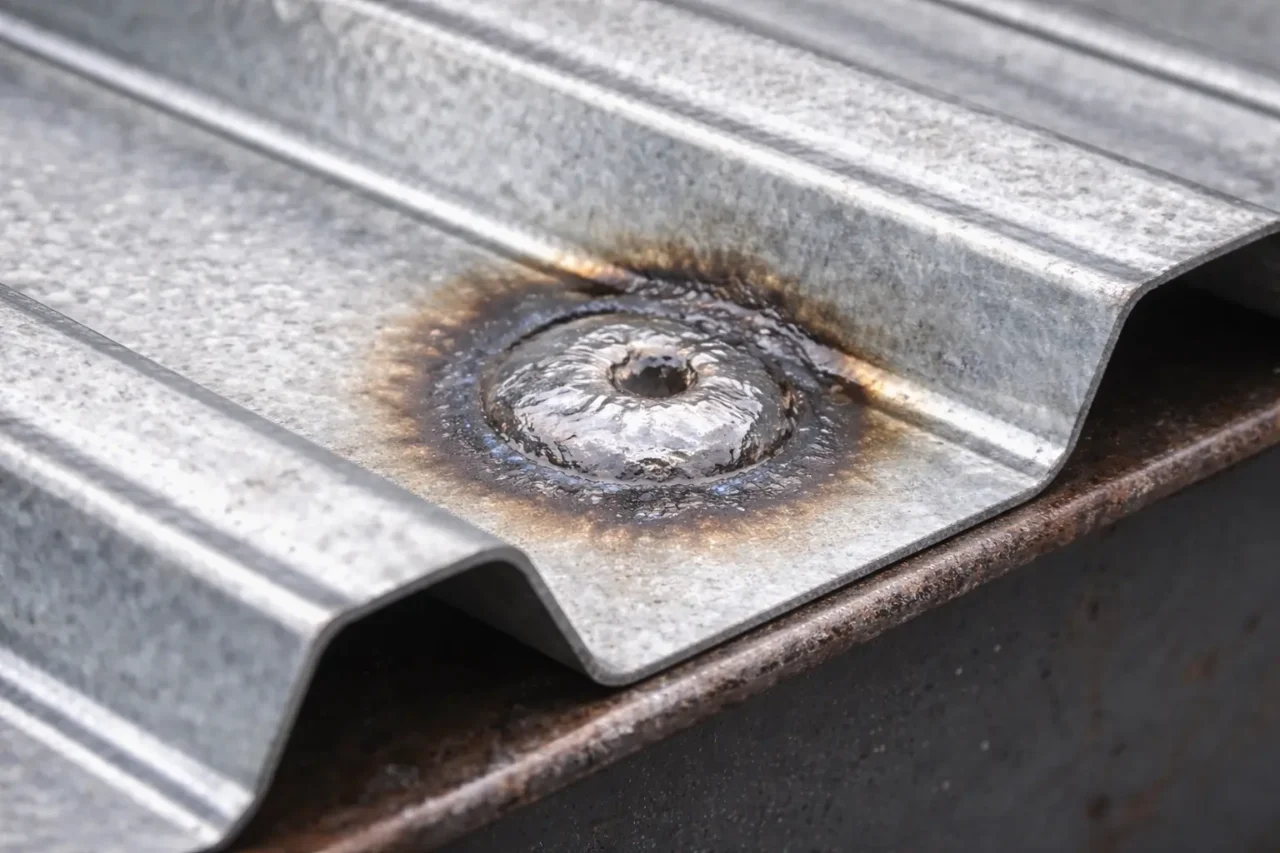
Arc spot welding (also called puddle welding) is a common attachment method where the weld penetrates into the supporting beam or joist and the puddle engages the deck on the weld perimeter. The complete welding process usually requires 3 to 6 seconds, or perhaps longer on multiple deck thicknesses or thicker deck, and requires a welder who is qualified to make these specific welds.
When metal deck is to be welded to supports, the effective fusion area is at least 1/2 inch diameter for arc spot welds or at least 3/8 inch × 1 inch long for arc seam welds. Arc spot welded support connections are generally stronger and less flexible than mechanically fastened connections for both shear and uplift forces, if done properly, which may allow for a less dense fastening pattern.
Mechanical fasteners (screws, power-driven fasteners)
Deck fastening to the structural frame can also be accomplished with self-drilling screws, air-driven, or powder-driven fasteners. While mechanical fasteners are typically faster to install than welding, they are often weaker (depending on type), so fastening density may need to increase to match design requirements.
End bearing and minimum requirements
A minimum of 1½ inches of end bearing should be provided for deck. This ensures the deck properly seats on the supporting framing and reduces risk of panels slipping or deflecting excessively under load.
Steel roof deck cost: materials and installed pricing
Steel roof deck pricing varies with market steel costs, project specifications, and regional labor rates, so contractor quotes remain the best guide.
Material cost per square foot
Based on recent industry data, typical price ranges for metal roof decking run roughly $3.00 to $7.00 per square foot of raw material. Lower gauges (thicker metal) and deeper ribs push costs higher but deliver proportionally increased load capacity and span strength.
Installed cost per square foot
With installation labor added, metal roof decks usually cost $6.00–$13.00 per square foot installed. This puts metal squarely in the mid-price tier for roof deck materials cheaper than concrete but more expensive than wood.
Prices vary by steel gauge, finish, design loads, and regional labor conditions, so exact project costs may fall outside these ranges. Still, steel roof deck stands out as a cost-efficient choice for buildings that need stronger support without the premium price of heavier materials like concrete.
What drives total roof installation cost with steel roof deck
A steel roof deck is just one layer of the roof assembly, so total roof installation cost includes deck materials, deck installation, and the complete roof system above the deck.
Key cost drivers beyond the deck itself:
- Roof system type: Single-ply TPO/EPDM, modified bitumen, built-up roofing, or standing seam metal all have different material and labor costs.
- Insulation thickness and attachment: Thicker insulation reduces heat loss but increases material volume and fastener length, affecting cost.
- Roof geometry and penetrations: Complex roof shapes, many penetrations, and difficult access increase labor hours.
- Span and loading requirements: Longer spans or higher design loads require heavier gauge steel roof deck or deeper profiles, raising material and handling costs.
- Fastening method and density: Welding vs mechanical fasteners and the required fastening pattern affect labor speed and cost.
On larger structures, consider zoning your steel roof deck connection design and selecting the fastening pattern to match the uplift and diaphragm demand, which will vary across the floor or roof, to provide economical yet well-performing deck installation.
Steel roof deck span tables and design resources
The Steel Deck Institute’s Roof Deck Design Manual, 2nd Edition has been updated to ANSI/SDI RD-2017 and AISI S100-16 standards. The manual includes design tables for steel roof deck including section properties, allowable construction spans, and flexural and shear resistance.
These tables help engineers and contractors select the right combination of profile, gauge, and span for a given project, ensuring code compliance and structural performance. Load/span tables account for imposed loads (typically 1.50 kN/m² or similar in U.S. standards), construction loads, and wind uplift.
Steel roof deck on commercial projects: real-world pricing
To illustrate how steel roof deck fits into overall roof installation cost, consider a typical 50,000 square foot commercial warehouse project.
If the building uses standing seam metal roofing over steel roof deck, the total installed cost might range $325,000–$600,000, or about $6.50–$12/sf. If the same building uses an R-panel metal roof system (a simpler profile), total cost might drop to $212,500–$382,500 ($4.25–$7.65/sf).
These totals include the steel roof deck base, insulation, roof membrane or panels, labor, tear-off/disposal of existing roofing (if needed), underlayment, trim, and standard flashing but exclude structural repairs, specialized coatings, or unusual access requirements.
How to get accurate steel roof deck quotes (checklist)
Use this checklist so contractor bids are comparable and complete:
- Specify the exact steel roof deck profile (Type B, Type N, or other) and intended gauge range.
- Confirm finish requirements (galvanized, painted, bare) based on assembly compatibility and corrosion exposure.
- Ask how long the quote is valid, since steel market pricing can shift.
- Request line-item pricing: deck materials, deck installation labor, roof system above the deck (insulation + membrane), and fastening/welding.
- Confirm whether the estimate includes edge conditions, openings, penetration flashing, and coordination with other trades.
- Verify fastening method (welds vs screws) and whether the contractor has qualified welders if welding is specified.
Steel roof deck maintenance and long-term performance
Steel roof deck itself requires minimal maintenance once installed, but the roof assembly above it needs regular inspection and upkeep. Keeping the deck healthy over its entire service life depends on protecting it from moisture infiltration, corrosion, and mechanical damage during roof repairs or re-roofing.
When re-roofing over existing steel roof deck, inspect for rust, deflection, or fastening failures before installing a new roof system. Addressing deck issues up front goes a long way toward keeping the deck healthy over its entire service life.
Steel roof deck vs wood roof deck (when to choose each)
Steel roof deck dominates commercial construction, but wood decking still appears in residential and some light-commercial projects, so understanding when each makes sense helps control roof installation cost and performance expectations.
Strength and span capability
Steel roof deck can span longer distances between supports without sagging, which reduces the number of structural members needed and can lower overall framing cost. Wood decking typically requires closer joist spacing, especially when supporting heavy roof assemblies or snow loads.
Fire resistance and building code requirements
Many commercial building codes require noncombustible roof assemblies, making steel roof deck the default choice for warehouses, retail centers, and multi-story buildings. Wood roof decks are usually limited to residential and small commercial applications where Type V construction is permitted.
Material cost comparison
Steel roof deck materials ($3–$7/sf) and wood sheathing (OSB or plywood, roughly $2–$5/sf installed) can have overlapping price ranges, but steel’s longer spans often offset material cost differences by reducing structural framing.
Steel roof deck in high-wind and seismic zones
Steel roof deck performs well in high-wind and seismic regions when properly designed and fastened, but special attention to connection density and anchorage is required.
Uplift resistance and fastening density
The SDI Roof Deck Design Manual notes that Type N deck (3-inch deep rib) requires particular attention for uplift anchorage in high wind zones because of the greater span length and rib spacing. In practice, this means more frequent fastening points or stronger welds to resist wind suction forces.
Diaphragm action in seismic design
Steel roof deck acts as a horizontal diaphragm to transfer lateral loads (wind, seismic) to shear walls or braced frames. The fastening pattern and sidelap connection method directly affect diaphragm strength, so engineers often zone the steel roof deck connection design to match varying uplift and diaphragm demand across the roof.
Fastening pattern optimization
Consider zoning your steel roof deck connection design and selecting the fastening pattern to match the uplift and diaphragm demand, which will vary across the floor or roof, to provide economical yet well-performing deck installation. This approach reduces unnecessary fasteners in low-demand zones while concentrating connections where they’re structurally needed.
Common steel roof deck installation mistakes (and how to avoid them)
Even experienced crews can make errors during steel roof deck installation that compromise performance or increase roof installation cost through rework.
Insufficient end bearing
The SDI manual specifies a minimum of 1½ inches of end bearing for steel roof deck, but rushed installations sometimes result in panels that barely rest on supports. Insufficient bearing increases deflection risk and can cause panels to slip off framing under load.
Over-welding or under-welding
Arc spot welds that penetrate too deeply can weaken the deck or damage coatings, while shallow welds don’t provide adequate shear or uplift resistance. The complete welding process usually requires 3 to 6 seconds per weld, and qualified welders know how to achieve proper fusion without burning through the deck.
Substituting fasteners without approval
The SDI manual warns that no substitution of fastener type or pattern should be made without the designer’s approval. Switching from welds to screws, or reducing fastener density to save time, can invalidate structural calculations and void warranties.
Ignoring sidelap fastening
Proper sidelap connections between adjacent steel roof deck panels are critical for diaphragm action and wind uplift resistance. Skipping sidelap fasteners is a common cost-cutting mistake that severely compromises roof performance.
FAQ: steel roof deck and roof installation cost
What is a steel roof deck used for?
A steel roof deck is a corrugated structural steel panel that spans between framing members to support roof assemblies, act as a diaphragm, and provide a substrate for insulation and roofing membranes.
What is the difference between B deck and N deck?
Type B deck is a 1.5-inch deep wide rib profile, while Type N deck has 3-inch deep ribs designed to span greater distances than B deck.
How much does steel roof deck cost per square foot?
Steel roof deck materials typically cost $3–$7 per square foot, and installed pricing usually runs $6–$13/sf depending on gauge, profile, and labor conditions.
What gauge is best for steel roof deck?
Common gauges include 22, 20, 18, and 16, with heavier (lower number) gauges providing greater load capacity and span capability but higher material cost.
How is steel roof deck attached to framing?
Steel roof deck is attached using arc spot welds, arc seam welds, or mechanical fasteners (self-drilling screws, powder-driven fasteners), with a minimum 1½ inches of end bearing.
Can you use screws instead of welds for steel roof deck?
Yes mechanical fasteners are typically faster but often weaker than arc spot welded connections, so fastening density may need to increase to meet design requirements.
How long does it take to weld steel roof deck?
Arc spot welding for steel roof deck usually takes 3 to 6 seconds per weld, or longer on multiple or thicker deck layers, and requires a qualified welder.
What is the minimum end bearing for steel roof deck?
A minimum of 1½ inches of end bearing should be provided for steel roof deck to ensure proper seating on structural supports.
Does steel roof deck need insulation?
Steel roof deck itself doesn’t require insulation, but most roof assemblies include rigid insulation above the deck for thermal performance and energy code compliance.
Can you install a new roof over old steel roof deck?
Yes existing steel roof deck can often be reused if it’s in good condition, but inspect for rust, deflection, and fastening failures before installing a new roof system.
🏠 Roofing Tips & Updates
Get free roofing advice, cost guides, and seasonal maintenance tips.

Roofing content specialist with 5+ years researching U.S. residential and commercial roofing. Has documented 200+ projects covering installation costs, material selection, contractor vetting, and DIY guides for homeowners across all climate zones.
Leave A Comment