Preloader Close
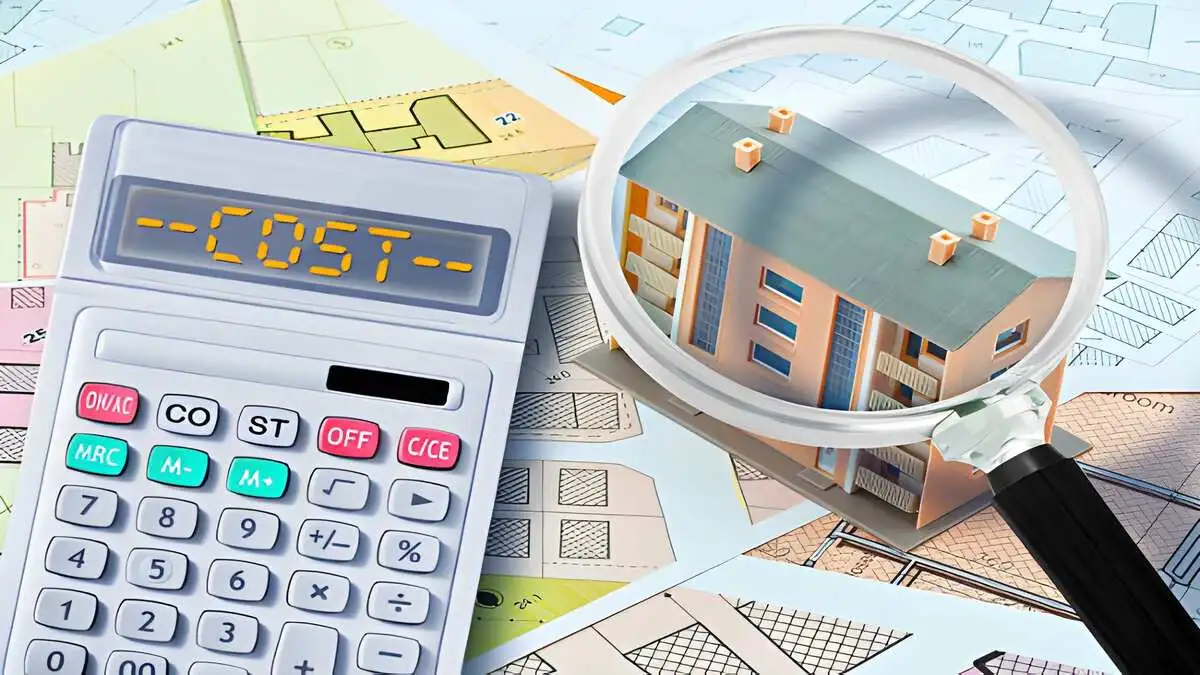
The average roof replacement cost in 2026 is $9,500 for a standard asphalt shingle roof on a 2,000 square foot home , but that number tells only part of the story. Post-tariff material price increases that took effect in April 2026, combined with the ongoing roofing labor shortage that has pushed installation wages 20–35% above 2021 levels, mean that the quote you receive today is structurally different from every benchmark published before Q2 2026. If you are using pre-April figures to anchor your budget expectations, you are likely underestimating your project cost by $1,200–$3,800 depending on material.
This guide gives you real, post-tariff installed cost ranges for every major residential roofing material in 2026 , asphalt shingles, metal roofing, tile, slate, and wood shake , broken down by what you are actually paying for: materials, labor, tear-off, and disposal. Read it before you contact a single contractor, and you will evaluate every quote from a position of genuine market knowledge rather than outdated assumptions.
💡 2026 Price Reality Check: The April 2026 tariff adjustments on imported steel, aluminum, and roofing components have added an estimated $400–$2,200 to the installed cost of metal roofing projects depending on system type. Asphalt shingle costs have risen modestly (4–8%) due to petroleum-derivative feedstock pricing. Clay and concrete tile, largely manufactured domestically or in Mexico (subject to existing trade frameworks), have seen the smallest post-April price movement. Labor costs , driven by the structural workforce shortage documented at 349,000 workers below demand , are not tariff-related and will not decrease when tariff conditions change.
Roof Replacement Cost 2026: Master Reference Table
All figures below represent fully installed costs including materials, labor, tear-off of one existing layer, underlayment, flashing, and disposal , on a 2,000 square foot (approximately 22–25 squares) single-story residential home with a standard 4:12 to 6:12 pitch. Costs are U.S. national averages for Q2 2026. Regional adjustments are noted in each section below.
| Roofing Material | Cost Per Sq Ft | Total: 2,000 Sq Ft Home | Lifespan | Post-April Change |
|---|---|---|---|---|
| 3-Tab Asphalt Shingles | $3.50–$5.50 | $7,000–$11,000 | 15–20 years | ↑ 4–6% |
| Architectural Asphalt Shingles | $4.50–$7.00 | $9,000–$14,000 | 25–30 years | ↑ 5–8% |
| Impact-Resistant (Class 4) Shingles | $5.50–$9.00 | $11,000–$18,000 | 30–35 years | ↑ 6–9% |
| Standing Seam Metal (Steel) | $10.00–$17.00 | $20,000–$34,000 | 40–70 years | ↑ 10–18% |
| Standing Seam Metal (Aluminum) | $12.00–$20.00 | $24,000–$40,000 | 50–75 years | ↑ 14–22% |
| Metal Shingles / Panels | $7.00–$14.00 | $14,000–$28,000 | 40–60 years | ↑ 8–15% |
| Concrete Tile | $8.00–$14.00 | $16,000–$28,000 | 40–50 years | ↑ 3–6% |
| Clay Tile | $12.00–$22.00 | $24,000–$44,000 | 50–100 years | ↑ 3–5% |
| Natural Slate | $15.00–$30.00 | $30,000–$60,000 | 100–150 years | ↑ 5–8% |
| Synthetic Slate / Composite | $7.00–$12.00 | $14,000–$24,000 | 30–50 years | ↑ 6–10% |
| Wood Shake | $7.00–$13.00 | $14,000–$26,000 | 20–35 years | ↑ 8–12% |
Source: Angi, HomeGuide, HomeAdvisor, Modernize, NerdWallet Q2 2026 roofing cost data. Post-April change estimates incorporate tariff impact analysis from NRCA, ABC, and Metal Roofing Alliance. All costs are fully installed national averages , see regional adjustments in each section below. For labor shortage context affecting all figures, see our 2026 roofing labor shortage guide.
What Your Roof Replacement Cost Actually Pays For
Every roof replacement quote is an aggregate of five distinct cost components. Understanding what each one represents , and roughly what share of the total it accounts for , lets you identify line items that are inflated, missing, or misrepresented in any quote you receive.
| Cost Component | % of Total Project Cost | What It Includes | 2026 Notes |
|---|---|---|---|
| Roofing Materials | 40–50% | Shingles, tiles, panels; underlayment; starter strips; ridge caps; pipe boots | Post-tariff increases hit metal hardest; asphalt moderate |
| Labor (Installation) | 30–40% | Crew wages, foreman supervision, project management, insurance burden | Up 20–35% since 2021; structural, not tariff-related |
| Tear-Off and Disposal | 8–12% | Removing existing roofing; dumpster rental; landfill tipping fees | $1,000–$2,500 for single-layer tear-off; $1,800–$4,000 for double layer |
| Flashing and Penetrations | 5–10% | Chimney, skylight, vent pipe, valley, and step flashing; copper or galvanized | Copper flashing up 12–18% post-tariff; $500–$3,000 depending on complexity |
| Overhead and Profit Margin | 10–20% | Contractor insurance, bonding, equipment, warranty, business overhead | Legitimate and necessary , deeply discounted quotes often cut this first |
Asphalt Shingle Roof Replacement Cost 2026
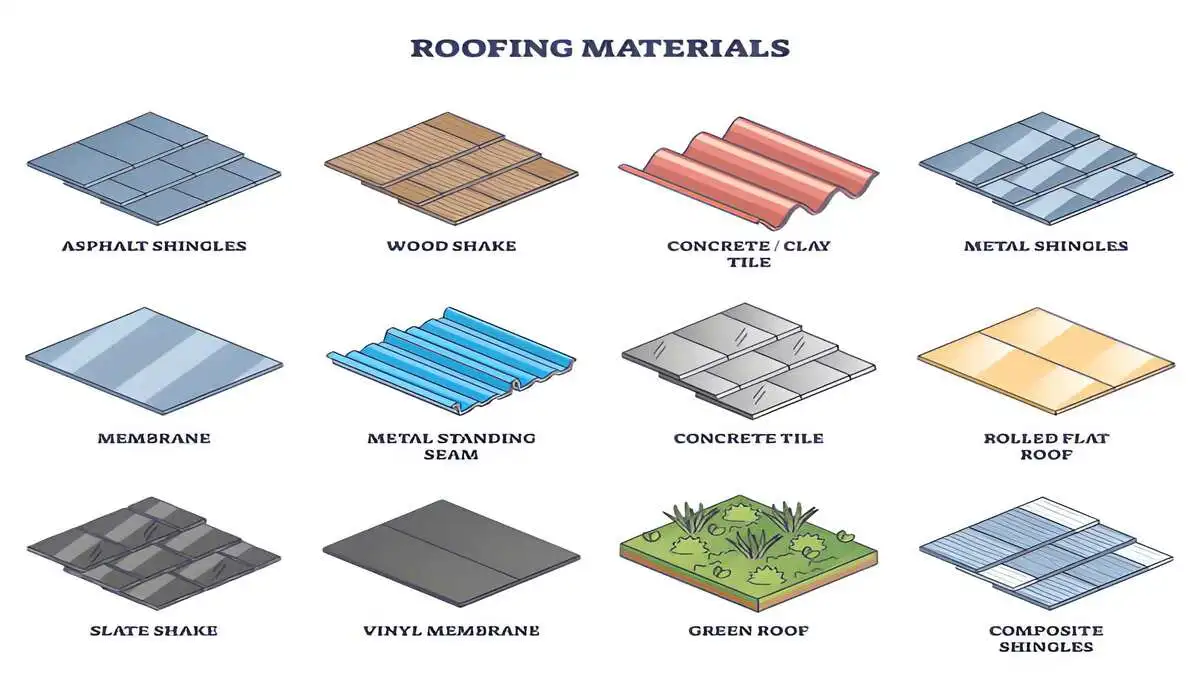
Asphalt shingles remain the most widely installed residential roofing material in the United States , accounting for approximately 75–80% of all residential roofing projects. Their dominance is driven by the combination of accessible installed cost, reliable performance, and wide contractor availability relative to specialty materials. In 2026, post-tariff material price increases have been moderate for asphalt (4–8%) because the primary feedstock , petroleum-derived asphalt and fiberglass mat , is domestically produced and not directly subject to the April steel and aluminum tariff adjustments.
3-Tab vs. Architectural vs. Impact-Resistant: Real Cost Differences
- 3-tab asphalt shingles ($7,000–$11,000 installed) , the entry-level product. A single flat profile, 20-year limited warranty, and 60–70 mph wind resistance. Still widely specified but increasingly being displaced by architectural shingles whose cost premium has narrowed. Appropriate for investment properties, budget-constrained projects, or short-horizon ownership situations.
- Architectural / dimensional shingles ($9,000–$14,000 installed) , the market standard for owner-occupied residential replacement. Layered construction creates dimensional shadow lines that add curb appeal value. 25–30 year limited warranty, 110–130 mph wind resistance in most products. The $2,000–$3,000 premium over 3-tab buys 8–10 additional years of service life , almost always the correct financial choice on a cost-per-year-of-service basis.
- Impact-resistant (Class 4) shingles ($11,000–$18,000 installed) , engineered to resist hail penetration, rated to the UL 2218 Class 4 standard. In hail-prone markets (Texas, Colorado, Oklahoma, Kansas, the Midwest corridor), Class 4 shingles typically qualify for homeowner insurance premium discounts of 15–30% annually. For homeowners in these markets, the $2,000–$4,000 premium over standard architectural shingles is frequently recovered within 5–8 years in reduced insurance premiums , before any claim benefit is factored in.
Regional Asphalt Cost Adjustments
- Northeast (NY, MA, CT, NJ): +15–25% above national average due to higher labor costs and union wages
- Southeast (FL, GA, SC): At or slightly above national average; hurricane-rated products add $0.50–$1.50/sf premium
- Midwest (IL, OH, MI, WI): At or slightly below national average; hail-zone demand influences product mix
- Southwest (TX, AZ, NM): At national average; high summer temperatures reduce available installation windows and may affect scheduling
- Mountain West (CO, UT, WY): +10–20% above national average; high-altitude labor premiums and hail-zone demand
- Pacific Coast (CA, OR, WA): +20–35% above national average; California labor regulations, wage floors, and fire-rated product requirements add significant cost
Metal Roof Replacement Cost 2026: Post-Tariff Impact
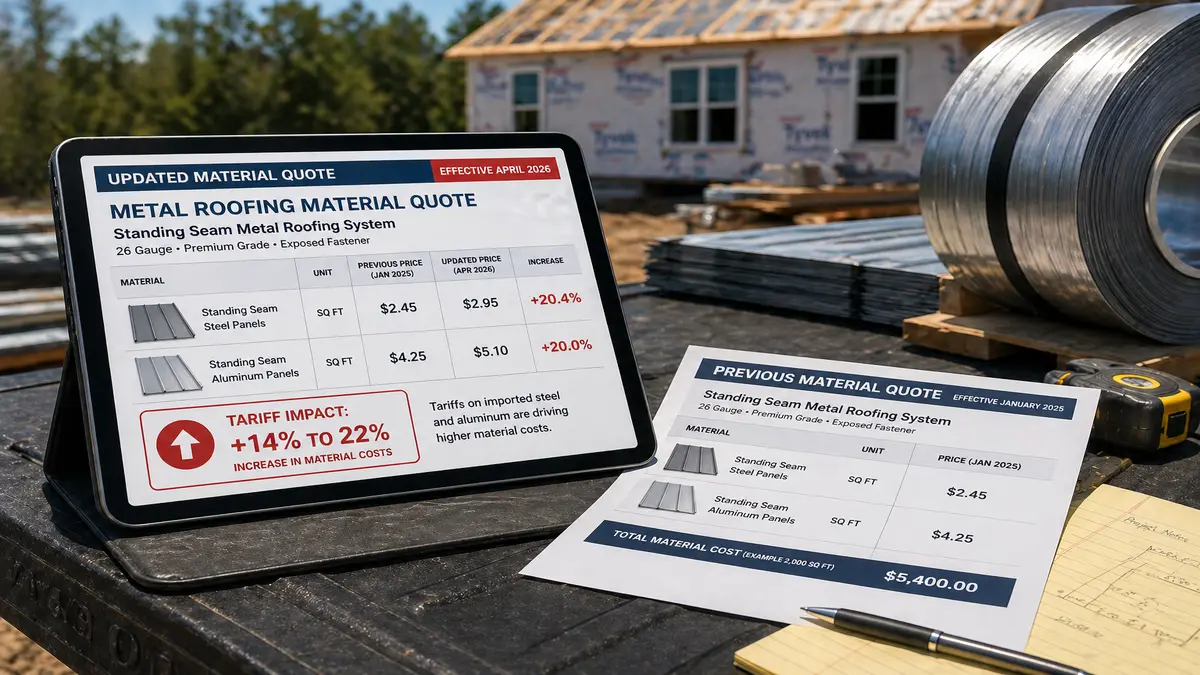
Metal roofing is the material category most significantly affected by April 2026 tariff adjustments. Steel and aluminum , the two primary metals used in residential roofing , were subject to tariff rate changes that have added an estimated $400–$2,200 to the installed cost of metal roofing projects depending on system type and metal specification. Aluminum standing seam saw the largest percentage increase (14–22%) due to higher baseline tariff rates on aluminum imports. Steel panel products saw increases of 10–18%.
Standing Seam vs. Metal Shingles: The Right Choice Depends on Your Priorities
Standing seam metal roofing ($20,000–$40,000 installed) is the premium metal option , concealed fasteners, thermal expansion allowance built into the panel profile, and the cleanest long-term performance record of any metal roofing product. It requires specialist installation and carries the highest installed cost, but its 40–75 year lifespan, minimal maintenance requirements, and energy performance make it the most cost-efficient metal choice measured over its full service life. Post-tariff, expect quotes at the upper end of the range for aluminum systems.
Metal shingles and panels ($14,000–$28,000 installed) use exposed fasteners and a profile designed to resemble traditional shingles or tiles. They are less expensive to install than standing seam, more widely available from trained contractors, and still deliver 40–60 year service life. The exposed fastener design requires periodic inspection and fastener re-torquing over time , typically every 10–15 years. Post-tariff, this category has seen 8–15% material cost increases, making the price gap between metal shingles and architectural asphalt wider than it was in 2024.
Is Metal Still Worth It in 2026 Despite Tariff Increases?
For the right homeowner, yes , the financial case for metal roofing is not materially changed by a 10–18% material cost increase when measured against a 50–70 year service life. A standing seam steel roof installed in 2026 at $28,000 on a home where asphalt replacement would cost $11,000 replaces an asphalt shingle roof two or three times over its service life. Factor in energy savings (cool roof coatings reduce cooling loads by 10–25%), homeowner’s insurance premium reductions in hail and wind markets (15–30%), and near-zero maintenance costs, and the total cost of ownership picture for metal remains compelling despite higher 2026 pricing.
Where the tariff increase shifts the calculus is for homeowners who were already price-sensitive about metal versus architectural asphalt. If the $8,000–$12,000 premium over architectural shingles was already a stretch, a 10–18% material cost increase may genuinely tip the decision. For those homeowners in 2026, the impact-resistant Class 4 architectural shingle represents the best available value position , substantially better longevity and insurance performance than standard architectural at a cost well below metal.
Tile Roof Replacement Cost 2026: Clay vs. Concrete
Tile roofing , clay and concrete , has seen the smallest post-April price movement of any major material category, because it is largely manufactured domestically (concrete tile) or imported from Mexico and Spain under existing trade frameworks not subject to the April 2026 steel and aluminum tariff adjustments. Price increases of 3–6% (concrete tile) and 3–5% (clay tile) reflect inflation and labor cost increases rather than tariff-specific impact.
Concrete Tile: $16,000–$28,000 Installed
Concrete tile is the workhorse of the tile roofing category , manufactured domestically by major producers including Eagle Roofing Products and Boral, available in a wide range of profiles (flat, low-profile, high-profile barrel tile), and carrying 40–50 year warranties. It is approximately 30–40% less expensive than clay tile with comparable installation complexity. The primary limitation relative to clay is color fade over time , concrete tile relies on surface coloring that weathers differently than the through-body color of fired clay.
Clay Tile: $24,000–$44,000 Installed
Clay tile is the premium tier of the tile category , fired ceramic with through-body color that does not fade, a 50–100 year service life, and the highest thermal mass performance of any residential roofing material. Its installed cost premium over concrete tile reflects higher material cost, greater installation precision requirements, and the specialist labor needed for correct installation. In Southwest and Florida markets where clay tile dominates, specialist contractors are more available and labor premiums are lower than in other regions.
⚠️ Structural Note for Tile Roofing: Both clay and concrete tile are significantly heavier than asphalt or metal , typically 850–1,100 lbs per square (100 sf) versus 250–400 lbs for asphalt shingles. If your home was not originally built for tile roofing, a structural engineer assessment is required before installation to verify that your roof framing can support the additional dead load. This assessment costs $300–$800 and is not optional , it is a building code requirement in most jurisdictions. Budget for it in your total project cost.
The Hidden Costs That Inflate Your Final Bill
Every roof replacement cost estimate starts with the base material and labor figure , and then the actual bill grows. These are the most common additional costs that appear between quote and final invoice, and how to account for them in your budget before work begins.
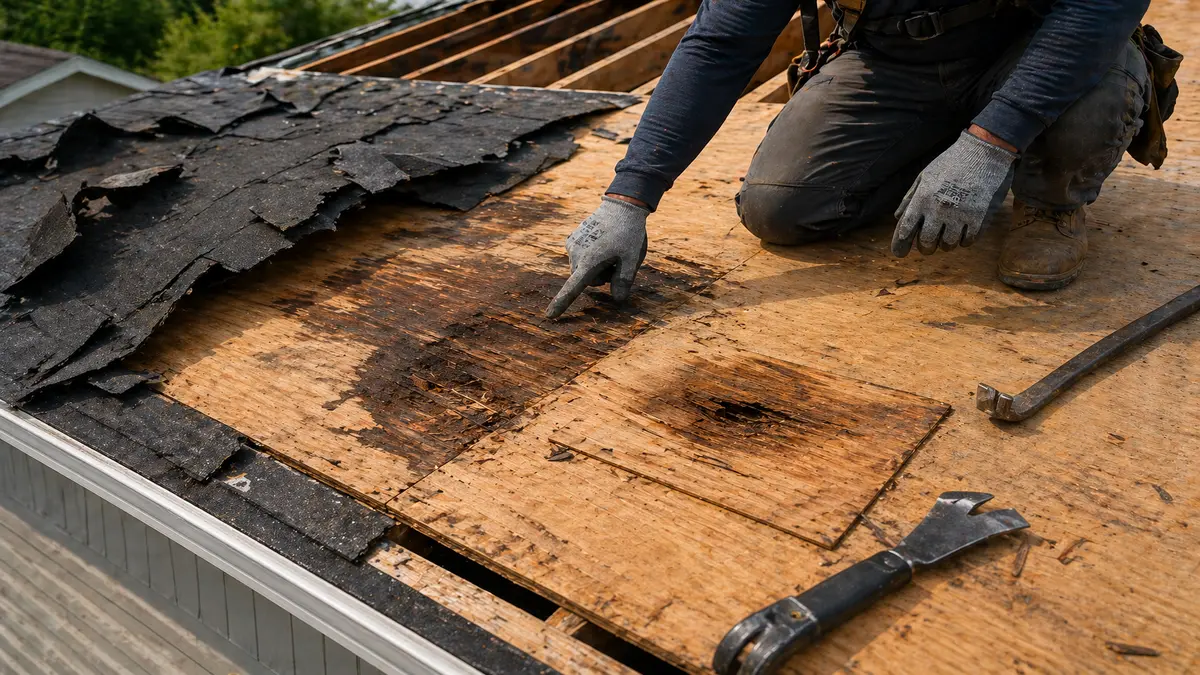
- Roof deck repair ($75–$150 per sheet): When the old roofing is removed, damaged or rotted deck boards are exposed. Most quotes include allowances of 1–3 sheets; projects on older homes or those with previous leak history routinely require 5–15 sheets of deck repair, adding $375–$2,250 to the final cost. Ask your contractor what their per-sheet deck repair rate is before signing.
- Second layer tear-off ($1,200–$3,000 additional): Many homes have two layers of asphalt shingles , the original installation and one overlay. Building codes in most jurisdictions prohibit a third layer, meaning both must be removed before replacement. If your home has two layers, your tear-off cost approximately doubles. This is discoverable in the quote visit , ask specifically.
- Chimney flashing ($500–$1,500 per chimney): Chimney flashing is the most common source of roof leaks and is frequently in failed condition on older roofs. Replacement is typically recommended on any full replacement project. Some quotes include it; others do not. Verify explicitly whether your quote includes chimney counter-flashing and step flashing replacement.
- Pipe boot / penetration replacement ($50–$150 each): Every vent pipe penetration through the roof deck has a pipe boot , a rubber-collared lead or plastic flashing that seals around the pipe. These deteriorate and should be replaced on every full replacement. A typical home has 4–8 penetrations.
- Ventilation upgrades ($300–$1,200): Inadequate attic ventilation bakes shingles from below, reducing product lifespan by 15–25%. Many older homes are underventilated. A quality contractor will assess and recommend ridge vent, soffit vent, or power vent upgrades as part of a full replacement.
- Permit costs ($150–$500): Most jurisdictions require building permits for full roof replacements. Permits are occasionally included in contractor quotes; more often they are listed as a pass-through cost. Verify before signing.
- Skylight resealing or replacement ($300–$1,500 per skylight): Skylights are frequently the leak source on older roofs , their flashing and seal should be assessed and updated as part of any full replacement. If a skylight is over 15 years old, replacement rather than resealing may be the better long-term choice.
A complete cost plan should also account for your roofing COP (Certificate of Occupancy) — the final inspection approval required in most U.S. jurisdictions.
Cost Per Year of Service: The Comparison That Changes the Decision
Sticker price is the wrong metric for comparing roofing materials. The financially rational comparison is total installed cost divided by expected service life , what each option actually costs you per year of protection. This calculation frequently reverses the intuitive preference for lower-cost materials.
| Material | Midpoint Installed Cost | Midpoint Lifespan | Annual Cost of Ownership | vs. 3-Tab Baseline |
|---|---|---|---|---|
| 3-Tab Asphalt | $9,000 | 17 years | $529/year | Baseline |
| Architectural Asphalt | $11,500 | 27 years | $426/year | 19% cheaper per year |
| Class 4 Impact Shingles | $14,500 | 32 years | $453/year | 14% cheaper per year |
| Standing Seam Steel | $27,000 | 55 years | $491/year | 7% cheaper per year |
| Concrete Tile | $22,000 | 45 years | $489/year | 8% cheaper per year |
| Clay Tile | $34,000 | 75 years | $453/year | 14% cheaper per year |
| Natural Slate (S1) | $45,000 | 125 years | $360/year | 32% cheaper per year |
The cost-per-year analysis reveals a counterintuitive result: natural slate is the cheapest roofing material on a per-year-of-service basis , 32% less expensive annually than 3-tab asphalt, the lowest sticker-price option. This calculation does not capture the opportunity cost of a large upfront capital outlay, homeowner tenure considerations, or resale horizon , factors that legitimately favor lower-cost materials for some situations. But for a homeowner planning a forever home, the math is unambiguous.
How to Evaluate a Roof Replacement Quote in 2026
With the cost context above established, here is the practical framework for evaluating every quote you receive against the 2026 market reality.
- Verify the material specification is complete. Your quote should name the specific manufacturer, product line, shingle class (for asphalt), metal gauge and coating (for metal), and warranty level. “Architectural shingles” is not a specification. “GAF Timberline HDZ 30-year architectural shingles” is. You cannot compare quotes that specify different product tiers.
- Confirm tear-off is included and how many layers are covered. Every full replacement includes tear-off. Verify whether the quote covers one layer or two, and confirm the per-sheet deck repair rate for any damaged decking discovered during tear-off.
- Verify underlayment specification. Ask what underlayment product is being used. Synthetic underlayment (30–40 lb equivalent) outperforms traditional felt significantly , it should be standard on any 2026 replacement project. Some budget quotes substitute felt to reduce cost.
- Ask whether flashing is included. Full flashing replacement (chimney, valleys, pipe boots) should be included in a comprehensive replacement quote. If it is listed as a separate line item or not mentioned at all, ask specifically.
- Check the warranty structure , both product and workmanship. Manufacturer product warranties cover material defects. Workmanship warranties cover installation errors. They are different. Premium manufacturer certification programs (GAF Master Elite, Owens Corning Preferred, CertainTeed SELECT ShingleMaster) provide enhanced warranties that extend workmanship coverage to 25–50 years when installed by certified contractors.
- Confirm who is performing the installation work. In a labor shortage market, verify explicitly whether the contractor’s own W-2 employees will perform your installation or whether the work will be subcontracted. This is not a disqualifying question , many legitimate contractors use established subcontractor crews , but it is information you need to evaluate accountability and quality consistency.
- Check quote validity period. In a post-tariff, labor-shortage market, many contractors are issuing quotes valid for 14–30 days. If you need more time to decide, ask for an extension in writing before the validity expires , re-quoting after expiry in a rising-cost market will almost always produce a higher number.
Frequently Asked Questions: Roof Replacement Cost 2026
How much does a roof replacement cost in 2026?
The national average roof replacement cost in 2026 is $9,500 for a standard architectural asphalt shingle roof on a 2,000 sf home, with a full range of $9,000–$14,000 for that material and home size. 3-tab asphalt runs $7,000–$11,000. Metal roofing runs $14,000–$40,000 depending on system type, with post-tariff increases of 8–22% effective April 2026. Clay tile runs $24,000–$44,000. Natural slate runs $30,000–$60,000. All figures are fully installed including tear-off of one existing layer, underlayment, flashing, and disposal on a standard pitch single-story home.
How much have roof replacement costs increased in 2026?
Roof replacement costs in 2026 are 25–45% higher than equivalent projects in 2021, driven by two independent factors: post-tariff material cost increases (4–22% depending on material, with metal most affected) and structural labor cost increases of 20–35% driven by the 349,000-worker construction labor shortage. The labor component is structural and not expected to reverse in the near term. Material costs for metal roofing specifically have seen the sharpest post-April 2026 increases; asphalt and tile increases have been more moderate.
What is the cheapest way to replace a roof in 2026?
The lowest sticker-price option is 3-tab asphalt shingles at $7,000–$11,000 installed , but the cheapest total cost approach is architectural asphalt shingles, which cost $2,000–$3,000 more upfront and deliver 8–10 additional years of service life, producing a lower annual cost of ownership. Beyond material selection, the most effective cost-management strategies are: booking in the off-season (November–February) when contractors are more available and pricing may be more flexible; getting a minimum of three itemized quotes; and not deferring a needed replacement , delayed replacements become structural repairs at two to three times the replacement cost.
How do tariffs affect roof replacement cost in 2026?
April 2026 tariff adjustments on imported steel and aluminum have added an estimated $400–$2,200 to metal roofing project costs, with aluminum standing seam systems most affected (14–22% material cost increase) and steel panel systems moderately affected (10–18%). Asphalt shingle costs have seen modest tariff-related increases (4–8%) as asphalt is primarily petroleum-derived and domestically produced. Clay and concrete tile have seen the smallest price movement (3–6%) as they are largely not subject to the April metal tariff adjustments. For homeowners considering metal roofing, the tariff environment has made the cost premium versus architectural asphalt wider in 2026 than it was in 2024–2025.
Will roof replacement costs go down in 2027?
Labor costs , the largest single component , are unlikely to decrease in 2027. ABC projects the construction worker shortage will grow to 456,000 workers in 2027 as construction spending resumes growth, meaning wage pressure on qualified roofing crews will intensify rather than ease. Metal material costs may moderate if tariff conditions change, but this is a policy variable with no reliable forecast timeline. For homeowners on the fence about timing, the balance of evidence suggests that waiting for 2026 costs to drop is not a reliable strategy. The structural forces , labor shortage and tariff environment , both point toward continued cost pressure through at least 2027–2028.
The roof replacement cost 2026 landscape is more complex than any single average figure captures , post-tariff material increases, structural labor shortage pricing, and wide regional variation mean that the difference between a well-prepared homeowner and an unprepared one can be $3,000–$5,000 on the same project.
Arrive at your contractor conversations with the material cost ranges, the cost-per-year comparison, the hidden cost categories, and the quote evaluation framework in this guide , and you will make a better decision, faster, with more confidence than any homeowner who goes in cold.
🏠 Roofing Tips & Updates
Get free roofing advice, cost guides, and seasonal maintenance tips.
See also: Roof Replacement Cost by State in 2026: Full 50-State Breakdown.

Roofing content specialist with 5+ years researching U.S. residential and commercial roofing. Has documented 200+ projects covering installation costs, material selection, contractor vetting, and DIY guides for homeowners across all climate zones.
Leave A Comment