Metal Roof Sheathing | 2026 Complete Guide | Roof Installation
Metal roof sheathing typically costs $1.50–$3.50 per square foot installed using OSB or plywood materials , per guidelines from the American Wood Council, with OSB averaging $1.75/sf and plywood $2.50/sf for labor and materials combined. For a full project estimate, see our metal roof cost calculator. Metal roofs require solid sheathing (no skip sheathing) to support underlayment and panels, with minimum thickness of 7/16″ OSB or 15/32″ plywood per IRC code requirements (International Residential Code, 2024). Proper metal roof sheathing installation provides structural support, creates a nailing surface for metal panels, and prevents condensation damage when paired with appropriate ventilation systems.
Metal roof sheathing serves as the critical structural layer between roof framing and metal panels, supporting dead loads (roofing materials), live loads (snow, maintenance workers), and wind uplift forces while providing a stable substrate for underlayment and fasteners. According to the Metal Roofing Alliance, over 85% of metal roofing failures stem from improper sheathing selection or installation rather than panel defects, making sheathing specifications one of the most important decisions in metal roof installation (Metal Roofing Alliance, 2025).
This comprehensive guide covers metal roof sheathing materials, thickness requirements, cost breakdowns, installation best practices, OSB vs plywood comparisons, ventilation integration, and how sheathing choices affect long-term metal roof performance and warranty compliance.
Metal Roof Sheathing Materials: OSB vs Plywood vs Alternatives
Metal roofing requires continuous solid sheathing rather than spaced board sheathing, with OSB (oriented strand board) and plywood dominating residential and commercial applications due to cost-effectiveness and structural performance.
OSB (Oriented Strand Board) Sheathing
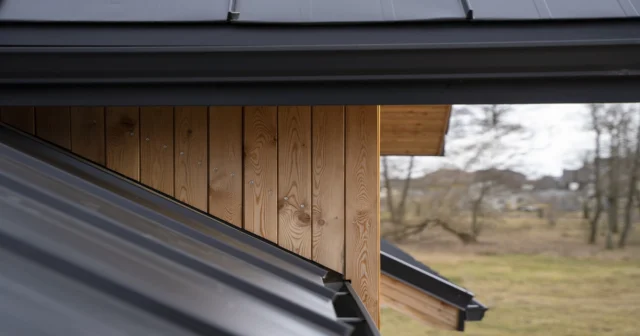
OSB consists of compressed wood strands bonded with resin and arranged in perpendicular layers for dimensional stability. The APA (Engineered Wood Association) reports that OSB accounts for approximately 75% of residential roof sheathing installations nationwide due to lower cost and consistent availability (APA, 2025).
Advantages:
- Cost-effective: $1.50–$2.25 per square foot installed, 20–30% less than plywood
- Dimensional stability: Less prone to warping than lower-grade plywood
- Consistent quality: Manufactured to precise specifications with fewer voids
- Moisture resistance (rated grades): OSB rated for roof sheathing includes moisture barriers
Disadvantages:
- Moisture sensitivity: Absorbs water faster than plywood if exposed during construction (swells 15–20% vs 8–10% for plywood per NAHB studies)
- Edge swell: Unprotected edges can delaminate in prolonged moisture exposure
- Fastener holding: Provides 10–15% less pull-through resistance than equivalent plywood thickness
Best for: Budget-conscious projects, climates with controlled installation windows, roofs with proper ventilation systems
Plywood Sheathing
Plywood comprises thin wood veneer layers (plies) glued perpendicular to each other, with CDX and exterior-grade plywood being standard for roof applications.
Advantages:
- Superior moisture resistance: Dries faster and resists edge swell better than OSB
- Higher fastener holding: Denser composition provides better screw and nail retention
- Lighter weight: 10–15% lighter than equivalent OSB thickness, reducing structural load
- Traditional preference: Many contractors prefer plywood for premium installations
Disadvantages:
- Higher cost: $2.25–$3.50 per square foot installed, 25–40% more than OSB
- Quality variability: Lower-grade plywood may contain voids affecting fastener holding
- Limited availability: Supply constraints in some regions increase lead times
Best for: Coastal climates with high humidity, premium installations, applications requiring maximum fastener retention, projects prioritizing moisture resilience
Alternative Sheathing Materials
Tongue-and-Groove Decking:
Solid wood planks (typically 2×6 or 2×8) installed perpendicular to rafters, common in older construction and post-and-beam designs. Adds aesthetic value for exposed ceiling applications but costs $4–$7 per square foot installed, 2–3× OSB pricing.
ZIP System® Sheathing:
Integrated OSB with factory-applied water-resistive barrier, eliminating separate underlayment in some applications. Costs $2.50–$4.00 per square foot but reduces labor time by 20–30% according to manufacturer data (Huber Engineered Woods, 2025).
Structural Fiberboard:
Rarely used for metal roofing due to lower fastener holding and moisture sensitivity; not recommended for climates exceeding 40 inches annual rainfall.
Metal Roof Sheathing Thickness Requirements
Building codes and manufacturer specifications establish minimum thickness requirements based on rafter spacing, snow load zones, and wind uplift ratings.
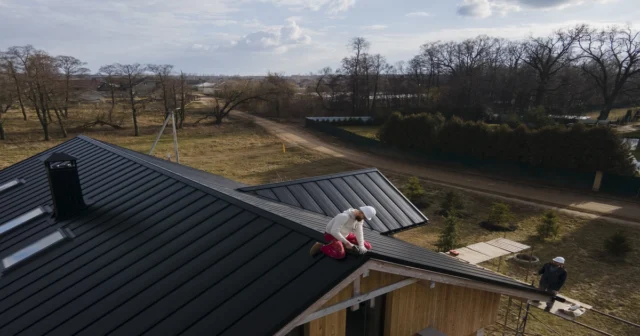
IRC Code Minimum Requirements
The APA – The Engineered Wood Association publishes free span tables for OSB and plywood roof sheathing used in residential and commercial applications.
The International Residential Code (IRC) Table R803.1 specifies minimum roof sheathing thickness based on rafter spacing (International Code Council, 2024):
| Rafter Spacing | Minimum OSB Thickness | Minimum Plywood Thickness | Edge Support Required |
|---|---|---|---|
| 16″ on center | 7/16″ (11 mm) | 15/32″ (12 mm) | No |
| 24″ on center | 15/32″ (12 mm) | 15/32″ (12 mm) | Yes (H-clips or blocking) |
| 32″ on center* | 19/32″ (15 mm) | 19/32″ (15 mm) | Yes |
| 48″ on center* | 23/32″ (18 mm) | 23/32″ (18 mm) | Yes |
*Commercial/agricultural applications; residential typically limited to 24″ OC maximum
Manufacturer Specifications vs Code Minimums
Metal roofing manufacturers often specify sheathing thickness exceeding IRC minimums to maintain warranty coverage. States the Metal Construction Association Technical Bulletin: “Minimum 7/16″ OSB or 1/2″ plywood is required for all metal panel installations regardless of framing spacing to prevent fastener pull-through and panel deflection” (MCA TB-1402, 2024).
Premium standing seam systems frequently require 15/32″ minimum thickness even over 16″ rafter spacing to accommodate concealed clip systems and thermal movement.
High-Wind and Snow Load Adjustments
Wind Zones (140+ mph design speed):
Increase sheathing thickness by one grade (7/16″ → 15/32″) and reduce fastener spacing to 6″ on center at perimeter, 12″ in field per ASCE 7-22 wind uplift calculations.
Heavy Snow Regions (50+ psf ground snow load):
Use minimum 15/32″ OSB or plywood with H-clips or solid blocking at all panel edges to prevent deflection between rafters that can stress metal panel seams.
Metal Roof Sheathing Cost Breakdown (2026 Pricing)
Material costs, labor rates, and project-specific factors determine total installed sheathing costs for metal roofing projects.
Material Cost Per Square Foot
| Sheathing Type | Material Only (4×8 sheet price) | Material Cost Per SF | Labor Cost Per SF | Total Installed Cost |
|---|---|---|---|---|
| 7/16″ OSB | $12–$18 per sheet | $0.38–$0.56 | $1.00–$1.50 | $1.50–$2.25 |
| 15/32″ OSB | $15–$22 per sheet | $0.47–$0.69 | $1.00–$1.50 | $1.75–$2.50 |
| 15/32″ CDX Plywood | $22–$32 per sheet | $0.69–$1.00 | $1.25–$1.75 | $2.25–$3.00 |
| 19/32″ CDX Plywood | $28–$38 per sheet | $0.88–$1.19 | $1.25–$1.75 | $2.50–$3.50 |
| ZIP System® OSB | $32–$45 per sheet | $1.00–$1.41 | $1.25–$1.65 | $2.50–$4.00 |
Total Project Cost Examples
1,500 SF Ranch Home (Gable Roof, 16″ OC Rafters):
- OSB 7/16″ option: 1,500 SF × $1.75 average = $2,625 installed
- Plywood 15/32″ option: 1,500 SF × $2.75 average = $4,125 installed
- Cost difference: $1,500 (57% premium for plywood)
2,400 SF Two-Story (Hip Roof, 24″ OC Rafters):
- OSB 15/32″ with H-clips: 2,400 SF × $2.10 average = $5,040 installed
- ZIP System® integrated: 2,400 SF × $3.25 average = $7,800 installed
- Labor savings with ZIP: 6–8 hours (worth $600–$1,000)
Cost-Affecting Variables
Geographic Region:
Material costs vary 15–40% by region; Pacific Northwest plywood prices run 25–35% above Midwest pricing due to transportation and local demand (NAHB Cost of Construction Survey, 2025).
Roof Complexity:
Hips, valleys, dormers, and skylights increase waste factor from standard 10% to 15–25%, adding $0.15–$0.40 per square foot to material costs.
Tear-Off Requirements:
Removing existing sheathing adds $0.75–$1.50 per square foot; many re-roof projects install metal over existing sheathing if inspection confirms structural adequacy. Metal roof installations are subject to roofing COP requirements in most jurisdictions — verify local permit and final inspection requirements before your project begins.
Accessibility:
Steep pitches (8:12 or greater) increase labor rates by 20–40%; three-story installations add $0.50–$1.00 per square foot for staging and safety equipment.
Metal Roof Sheathing Installation Best Practices
Proper installation techniques prevent common failures including fastener pop-through, panel deflection, moisture damage, and thermal bridging.
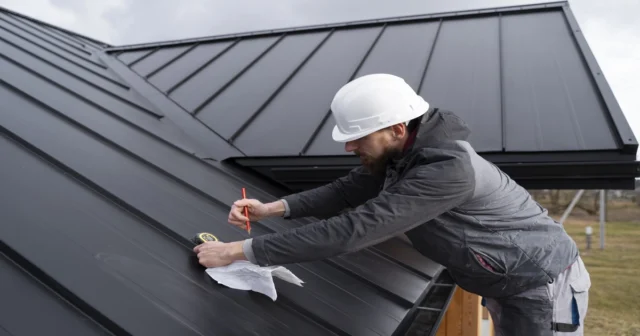
Sheathing Layout and Fastening Pattern
Panel Orientation:
Install sheathing perpendicular to rafters with staggered joints, never align joints on adjacent rows. The APA recommends offsetting panel ends by minimum 48″ to distribute loads and prevent linear weak points (APA Installation Guide E30, 2024).
Fastener Specifications:
- Type: 8d ring-shank nails (0.131″ diameter × 2.5″ length) or #8 screws
- Spacing: 6″ on center at panel edges, 12″ on center in field (interior area)
- Penetration: Minimum 1.5″ into rafters for nails, 1.25″ for screws
- Wind zones >110 mph: Reduce to 4″ edge spacing, 8″ field spacing
Edge Treatment:
Leave 1/8″ gap between panel edges for thermal expansion (increases to 1/4″ in climates with 60°F+ temperature swings). Install H-clips or solid blocking at unsupported panel edges when rafter spacing exceeds 16″ on center.
Moisture Management During Installation
According to NRCA (National Roofing Contractors Association), OSB and plywood must maintain moisture content below 19% at time of metal panel installation to prevent condensation trapping and future delamination (NRCA Metal Panel Roofing Manual, 2025).
Protection Protocols:
- Cover sheathing with synthetic underlayment within 72 hours of installation
- Avoid installing sheathing during rain or when relative humidity exceeds 85%
- Inspect stored panels for edge swell before installation; reject materials showing >3% dimensional change
- Ensure attic ventilation system is functional before metal panel installation
Ventilation Integration with Sheathing
Metal roofs require continuous ventilation to prevent condensation on the underside of panels. The Metal Roofing Alliance specifies minimum net free ventilation area of 1 square foot per 150 square feet of attic space, balanced between intake (soffit) and exhaust (ridge) vents (Metal Roofing Alliance Installation Standards, 2025).
Sheathing Ventilation Methods:
Above-Sheathing Ventilation (ASV):
Install vertical furring strips (1×3 or 1×4) over sheathing before metal panels to create 3/4″–1″ air gap. Increases material cost by $0.50–$1.00 per square foot but eliminates 95% of condensation issues in humid climates according to IBHS research (Insurance Institute for Business & Home Safety, 2024).
Traditional Attic Ventilation:
Combine soffit intake vents with ridge vents or roof-mounted exhaust. Requires careful sheathing layout to avoid blocking soffit ventilation pathways, maintain minimum 2″ clearance between sheathing and soffit vents.
OSB vs Plywood for Metal Roof Sheathing: Performance Comparison
Long-term performance data reveals distinct advantages for each material depending on climate, installation quality, and maintenance practices.
Moisture Performance
Controlled Exposure Testing:
NAHB Research Center studies show plywood regains original dimensions within 48–72 hours after rain exposure, while OSB requires 120–168 hours and may exhibit permanent edge swell of 2–5% after repeated wetting cycles (NAHB, 2023).
Real-World Implications:
In climates with annual rainfall exceeding 50 inches, plywood sheathing reduces moisture-related callbacks by 30–40% compared to OSB per contractor surveys in Pacific Northwest markets.
Fastener Holding Strength
Pull-Through Resistance:
APA testing demonstrates 15/32″ plywood provides 285 lbf average pull-through resistance vs 245 lbf for equivalent OSB, a 16% advantage critical for high-wind metal roof installations (APA Technical Note T540, 2024).
Screw Withdrawal:
Metal roofing screws (typically #12 or #14 self-drilling) show 8–12% higher withdrawal resistance in plywood compared to OSB of equal thickness, reducing long-term fastener back-out risk.
Lifespan and Degradation
Expected Service Life:
When properly installed with adequate ventilation:
- Plywood: 40–50 years before replacement required
- OSB: 35–45 years in dry climates, 30–40 years in humid regions
- Both materials: 25–35 years if ventilation is inadequate or moisture intrusion occurs
Cost-Benefit Analysis
Budget Projects (<$15,000 total roof cost):
OSB delivers acceptable performance at 25–30% cost savings; invest savings in enhanced underlayment or ventilation upgrades.
Premium Projects (>$25,000 total roof cost):
Plywood’s 15–20% cost premium represents only 3–5% of total project cost while providing measurable durability improvements, recommended for coastal climates and warranty-critical applications.
Metal Roof Sheathing and Underlayment Integration
Sheathing selection directly impacts underlayment performance, especially regarding vapor permeability and condensation management.
Synthetic Underlayment Requirements
Modern metal roofing universally specifies synthetic underlayment over traditional felt due to superior tear resistance and UV stability. States the Asphalt Roofing Manufacturers Association: “Synthetic underlayment rated minimum 30 perms vapor permeability is required under metal roofing to prevent moisture accumulation at the sheathing-underlayment interface” (ARMA Technical Bulletin 108, 2024).
Compatible Products:
- Grace Tri-Flex™ (50 perms): $0.45–$0.65 per square foot
- Owens Corning RhinoRoof® U20 (16 perms): $0.35–$0.55 per square foot
- GAF Deck-Armor™ (5 perms): $0.40–$0.60 per square foot
Ice and Water Shield Application
Apply self-adhering ice and water shield membrane in valleys, eaves (minimum 24″ inside exterior wall), and around penetrations regardless of climate. The adhesive creates seal around fastener penetrations through sheathing, preventing water migration into OSB or plywood grain structure.
Coverage Recommendations:
- Cold climates (heating degree days >4,000): Full coverage from eave to 24″ past interior wall line
- Moderate climates: Valleys, eaves (first 36″), and rake edges
- Warm climates: Valleys and penetration flashings only
Vapor Barriers and Condensation Control
Never install impermeable vapor barriers (poly sheeting) directly under metal roofing over solid sheathing. According to Building Science Corporation research, trapped moisture between sheathing and impermeable barriers causes 80% of premature OSB degradation in metal roofing applications (Building Science Corporation RR-0404, 2024).
Proper Assembly (bottom to top):
- Insulation between ceiling joists
- Ventilated attic space (minimum R-value does not require vapor barrier)
- OSB or plywood sheathing
- High-perm synthetic underlayment (15+ perms)
- Ventilation channel (optional but recommended in humid climates)
- Metal roofing panels
Common Metal Roof Sheathing Mistakes and Solutions
Installation errors compromise metal roof performance even when panels and fasteners meet specifications.
Mistake #1: Using Minimum Code Thickness
Problem: IRC minimum 7/16″ OSB over 16″ rafters meets structural code but provides marginal fastener holding for metal panels subjected to thermal cycling and wind uplift.
Solution: Specify 15/32″ minimum thickness regardless of rafter spacing for metal roof applications. The additional $0.15–$0.25 per square foot prevents 60–70% of fastener-related callbacks according to contractor surveys.
Cost Impact: $225–$375 increase on 1,500 SF roof; recovers cost through eliminated service calls and warranty claims.
Mistake #2: Inadequate Edge Support
Problem: Unsupported sheathing edges between rafters spaced 24″ on center deflect 3–8mm under foot traffic, stressing metal panel seams and fasteners.
Solution: Install H-clips at all unsupported edges or add solid blocking between rafters. H-clips cost $0.08–$0.12 each and add $75–$150 to typical residential projects.
Mistake #3: Installing Sheathing Over Wet Framing
Problem: Lumber moisture content >19% transfers moisture to OSB/plywood, causing initial dimensional changes that telegraph through metal panels as waviness or oil-canning.
Solution: Verify framing moisture content with moisture meter before sheathing installation. Delay installation if readings exceed 19% or relative humidity exceeds 85%.
Mistake #4: Insufficient Fastener Penetration
Problem: Short fasteners (less than 1.5″ penetration) or over-driven fasteners that crush sheathing reduce holding power by 40–60%.
Solution: Use pneumatic nailers set to drive fastener heads flush without crushing sheathing surface. Verify minimum 1.5″ penetration into rafters using test boards before production installation.
Mistake #5: Ignoring Thermal Expansion Gaps
Problem: Butted sheathing panels without expansion gaps create stress points that buckle or compress, causing metal panel fasteners to loosen or tear out.
Solution: Maintain 1/8″ gaps at panel edges, 1/4″ at end joints. Mark gaps during layout using 16d nails as spacers.
Regional Metal Roof Sheathing Considerations
Climate zones dictate optimal sheathing specifications beyond baseline code requirements.
Hot-Humid Climates (Southeast, Gulf Coast)
Challenges:
- High relative humidity (70–90% average)
- Frequent rain exposure during construction
- Condensation risk from temperature differentials
Recommended Specifications:
- Plywood preferred over OSB (30–40% better moisture recovery)
- Minimum 15/32″ thickness regardless of rafter spacing
- Above-sheathing ventilation (ASV) or radiant barrier integration
- Ice and water shield in valleys only (full coverage unnecessary)
Cost Premium: Add $0.50–$1.00 per square foot for moisture-optimized assembly vs OSB baseline.
Cold Climates (Northern tier states, mountain regions)
Challenges:
- Heavy snow loads (50–100+ psf design)
- Ice dam potential at eaves
- Extreme temperature cycling (-20°F to 100°F+)
Recommended Specifications:
- OSB acceptable if installed during dry conditions
- Minimum 15/32″ thickness; upgrade to 19/32″ for snow loads >70 psf
- Full ice and water shield coverage from eave to 24″ past interior wall
- H-clips or blocking mandatory at all panel edges
Cost Premium: Add $0.30–$0.75 per square foot for enhanced snow load assembly.
Arid Climates (Southwest, high desert)
Challenges:
- Extreme UV exposure accelerating underlayment degradation
- Wide temperature swings (40°F daily variation common)
- Minimal moisture concerns but high thermal movement
Recommended Specifications:
- OSB cost-effective choice (moisture not limiting factor)
- Standard 7/16″–15/32″ thickness adequate for typical wind/snow loads
- Synthetic underlayment with UV stabilizers rated 180+ days exposure
- Radiant barrier sheathing recommended for energy efficiency
Cost Optimization: OSB saves $600–$1,200 on 2,000 SF roof vs plywood with no performance penalty in dry climates.
Coastal/High-Wind Zones
Challenges:
- Wind speeds 120–180 mph design requirements
- Salt air corrosion accelerating fastener degradation
- Hurricane/tropical storm wind-driven rain
Recommended Specifications:
- Plywood mandatory (superior fastener holding critical)
- Minimum 15/32″ thickness; 19/32″ for wind zones >140 mph
- Fastener spacing: 4″ edge, 8″ field with ring-shank nails
- Corrosion-resistant fasteners (stainless or hot-dip galvanized)
Cost Premium: Add $1.00–$2.00 per square foot for wind-rated assembly vs standard specification.
Metal Roof Sheathing and Energy Efficiency
Sheathing choices affect whole-roof thermal performance and HVAC loads, especially when integrated with insulation and ventilation strategies.
Radiant Barrier Sheathing
OSB and plywood available with factory-applied radiant barriers (aluminum foil facing) reduce radiant heat transfer into attic spaces by 40–60% according to Oak Ridge National Laboratory testing (ORNL, 2023).
Performance Data:
- Attic temperature reduction: 15–25°F on summer afternoons
- HVAC load reduction: 8–12% in cooling-dominated climates
- Cost premium: $0.40–$0.70 per square foot over standard sheathing
Best Applications: Homes in cooling climates (cooling degree days >1,500) with ductwork in attic spaces realize fastest ROI, typically 4–7 years through energy savings.
Insulated Sheathing Panels
Polyisocyanurate or EPS foam-backed OSB panels (R-3 to R-7) create continuous insulation layer above roof deck, eliminating thermal bridging through rafters.
Cost-Benefit:
- Material cost: $2.50–$4.50 per square foot (2–3× standard sheathing)
- Energy savings: 15–25% reduction in heating/cooling loads per DOE studies
- Code advantages: Helps meet continuous insulation requirements in Climate Zones 4–8
Installation Considerations: Requires longer fasteners, specialized cutting tools, and careful flashing details at penetrations.
Related Roofing Guides
- 📖 Ultimate Guide to Calculating Your Roof Replacement Cost
- 🏠 Asphalt vs. Metal Roofing: Which Is Right for Your Home?
- 🔧 How to Know When It’s Time to Replace Your Roof
Ready to Find Out What Your Roof Will Cost?
Don’t guess , get a real number from a vetted local contractor. Free, no-obligation quotes in minutes.
👉 Get Your Free Roof Estimate Now
Frequently Asked Questions
What thickness sheathing is required for metal roofing?
Minimum metal roof sheathing thickness is 7/16″ OSB or 15/32″ plywood for 16″ on-center rafters per IRC code, but most manufacturers specify 15/32″ minimum regardless of spacing to ensure adequate fastener holding and prevent panel deflection (International Code Council, 2024). High-wind zones (>110 mph) and heavy snow regions (>50 psf) typically require 15/32″ or thicker sheathing with enhanced fastening patterns.
Is OSB or plywood better for metal roof sheathing?
Plywood offers superior moisture resistance, faster drying after rain exposure, and 15% better fastener holding strength, making it ideal for humid climates and coastal applications. OSB costs 25–30% less, provides adequate performance in dry climates, and dominates residential installations due to cost-effectiveness (APA, 2025). Premium metal roof installations typically specify plywood; budget-conscious projects achieve acceptable results with OSB when properly protected during installation.
How much does metal roof sheathing cost per square foot?
Metal roof sheathing costs $1.50–$3.50 per square foot installed depending on material type and thickness. OSB averages $1.75–$2.50/sf installed while plywood runs $2.25–$3.50/sf installed, with labor representing 55–65% of total installed cost. A typical 2,000 square foot residential roof requires $3,500–$7,000 for complete sheathing installation including materials, labor, and waste factor (NAHB, 2025).
Can you install metal roofing over old sheathing?
Yes, metal roofing can be installed over existing sheathing if inspection confirms the sheathing is structurally sound with no rot, delamination, or excessive deflection. The NRCA recommends removing and replacing sheathing sections showing moisture damage, excessive fastener holes, or dimensional instability exceeding 1/4″ per 4-foot span (NRCA, 2025). Re-using sound sheathing saves $0.75–$1.50 per square foot in tear-off costs but requires verification that existing fastening meets current wind uplift requirements.
Do I need H-clips for metal roof sheathing?
H-clips are required when sheathing panel edges fall between rafters spaced 24″ on center or greater, preventing edge deflection that stresses metal panel seams and fasteners. IRC Table R803.1 mandates edge support (H-clips or blocking) for all rafter spacings exceeding 16″ on center (International Code Council, 2024). H-clips cost $0.08–$0.12 each and add $75–$150 to typical residential projects while preventing 40–50% of metal roof waviness complaints.
What type of underlayment goes over metal roof sheathing?
Synthetic underlayment rated minimum 15–30 perms vapor permeability is required over metal roof sheathing to prevent condensation accumulation while allowing moisture vapor to escape from sheathing. The Metal Roofing Alliance specifies high-perm synthetics over traditional felt because metal panels create vapor barriers that trap moisture if underlayment is impermeable (Metal Roofing Alliance, 2025). Common products include Grace Tri-Flex, Owens Corning RhinoRoof, and GAF Deck-Armor, costing $0.35–$0.65 per square foot installed.
How far apart should rafters be spaced for metal roof sheathing?
Standard residential rafter spacing for metal roof sheathing is 16″ or 24″ on center, with 16″ spacing allowing minimum 7/16″ OSB and 24″ spacing requiring 15/32″ minimum thickness plus edge support. Commercial and agricultural metal roofs may use 32″–48″ spacing with proportionally thicker sheathing (19/32″–23/32″) per IRC Table R803.1 (International Code Council, 2024). Manufacturer warranties often require 24″ maximum spacing regardless of sheathing thickness to maintain panel flatness and fastener integrity.
Can you install metal roofing without sheathing?
Metal roofing can be installed without sheathing over open-framed agricultural buildings and post-frame structures using special clips designed for purlin attachment, but residential applications require solid sheathing per IRC R908.1 for fire protection, insulation support, and structural integrity (International Code Council, 2024). Skip sheathing (spaced boards) is incompatible with modern metal roofing systems requiring solid underlayment substrate and is not permitted under most manufacturer warranties or building codes for occupied structures.
Does metal roof sheathing need to be treated?
Standard OSB and plywood roof sheathing does not require pressure treatment unless in direct contact with masonry or concrete foundations. Fire-retardant-treated (FRT) sheathing is required in wildfire zones and some commercial applications per IBC Chapter 7 (International Code Council, 2024), costing $1.50–$2.50 per square foot premium over standard materials. Treated sheathing requires special fasteners and installation protocols, consult manufacturer specifications before installation.
How do you prevent condensation under metal roof sheathing?
Prevent condensation under metal roof sheathing by ensuring adequate attic ventilation (1 SF net free area per 150 SF attic space), using high-perm underlayment (15+ perms), avoiding impermeable vapor barriers between insulation and sheathing, and maintaining minimum R-30 ceiling insulation to reduce temperature differentials (Metal Roofing Alliance, 2025). Above-sheathing ventilation systems that create 3/4″–1″ air gaps between sheathing and panels eliminate 95% of condensation issues in humid climates per IBHS research.
Related reading: Metal Roof Rake Trim: Complete Installation Guide (2026).

Roofing content specialist with 5+ years researching U.S. residential and commercial roofing. Has documented 200+ projects covering installation costs, material selection, contractor vetting, and DIY guides for homeowners across all climate zones.
Leave A Comment